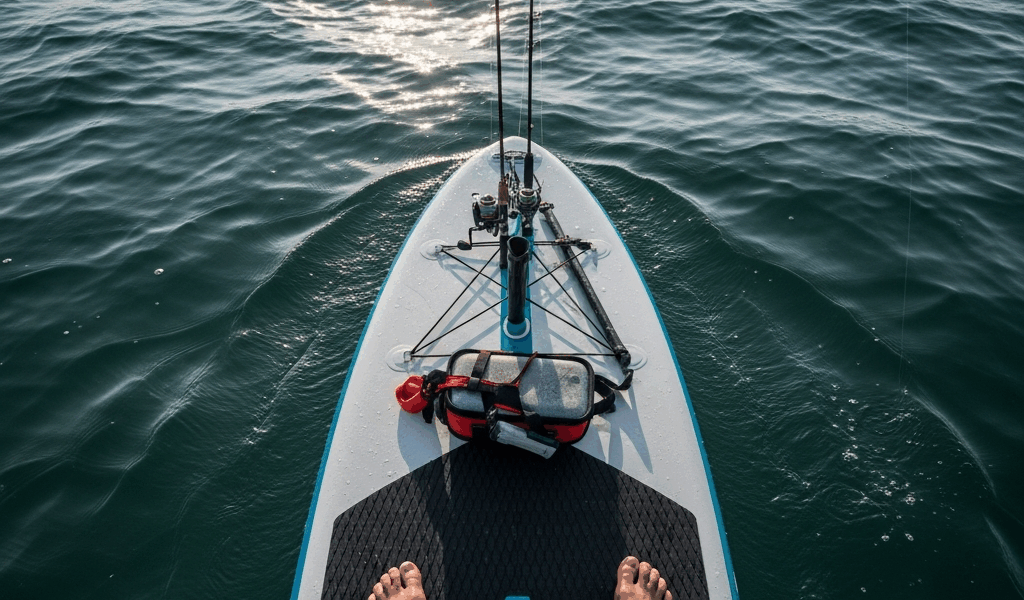
Why Your Paddleboard Keeps Tipping in the First Place
Paddleboard balance has gotten complicated with all the conflicting advice flying around. I spent an entire summer fighting instability on Puget Sound before finally figuring out what was actually happening — and it wasn’t what I expected. The problem isn’t usually you. It’s typically a combination of factors working against you all at once.
As someone who’s fished from paddleboards in Seattle’s variable water for three seasons, I learned everything there is to know about why tipping happens. Your board width, weight distribution, gear placement, and stance all play roles. Add fishing tackle into the mix, and things get messier fast.
The most common culprit? Improper weight distribution. Most paddleboarders place their tackle box, cooler, or fishing rod bag wherever it fits, not where it helps balance. That’s your first mistake — and I made it constantly. A tackle box mounted even slightly forward or aft shifts your board’s center of gravity and dramatically increases tipping tendency. I didn’t realize my $400 Plano tackle box was positioned three feet from the board’s center line until I actually measured it.
Stance issues come second. Standing with feet too close together, knees locked straight, or weight shifted toward the rails instead of the centerline creates constant micro-adjustments. Your body works overtime to stay stable, and you’ll exhaust yourself before ever landing a fish.
Water conditions matter too. Puget Sound’s chop creates lateral forces that flat-water paddleboards handle poorly. If you’re fishing in variable conditions — sometimes choppy, sometimes calm — your balance baseline keeps shifting. A stance that works on glass-flat water feels unstable in two-foot chop.
Finally, board volume and width directly affect stability. A 10-foot by 28-inch board handles fishing weight differently than a 10-foot by 25-inch board. The narrower option tips easier, especially when you’re casting and shifting your weight dynamically.
Fix Your Stance and Weight Distribution
Here’s what actually works. Start with your feet.
Position them shoulder-width apart. Not hip-width. Not close together. Shoulder-width — that’s 16-18 inches between foot centers for most people. I checked this with a tape measure on my board once, totally worth the 30 seconds. This gives you a stable base without overextending your balance points.
Bend your knees slightly. Not a squat. A gentle bend of maybe 15-20 degrees. Locked knees transfer every small movement directly to your hips and upper body, amplifying instability. Slightly bent knees act like shock absorbers, letting the board move underneath you without throwing off your balance.
Weight distribution is critical. Your weight should sit centered over the board’s centerline, not toward the rails. Most people unconsciously creep toward the edges while standing — don’t make my mistake. Keep your chest and torso aligned vertically with the board’s midpoint. Imagine a plumb line running from your belly button straight down through the board’s center. That’s where your weight lives.
Now, casting changes everything. When you’re fishing, you’re not just standing — you’re rotating, reaching, and shifting your weight dynamically. That’s probably where you’ve tipped the most.
For casting stance: keep your base wide during the cast. Don’t shift all your weight to your back foot like you would on land. Instead, distribute weight 60-40 between your back and front foot. As you execute the cast, your torso rotates but your feet stay planted. The board will rock slightly — that’s normal and controlled. Practice keeping your hips and knees engaged; they’re your real stabilizers, not your feet.
A fishing-specific tip I wish I’d learned earlier: your tackle box placement determines everything. Center it. Not toward the nose, not toward the stern. Dead center, ideally within 12 inches of the board’s midpoint. An off-center tackle box makes the tipping point shift constantly. You’ll find yourself compensating unconsciously, exhausting yourself while you fish.
Same logic applies to your cooler, rod rack, or any gear. Low and central beats high and anywhere. Weight positioned 12 inches above the waterline tips you faster than weight at waterline level. Gravity works against you when gear sits too high.
Reposition Your Fishing Gear to Improve Stability
Honestly? This is where most paddleboarders could solve their tipping problem without buying anything new.
Start by auditing your current setup. Where’s your tackle box? Measure the distance from the board’s center. If it’s more than 18 inches forward or aft, move it. I used a simple 12-inch ruler to mark the center point on my board with a piece of tape. Once I moved my Plano 1374 tackle box six feet closer to center, my balance improved immediately.
Distribute secondary gear (rod holders, cooler, anchor system) symmetrically. If your cooler sits on one side, don’t put your rod bag on the other side. Balance opposing weights. This feels fussy, but it prevents constant weight-balancing micro-adjustments.
Keep your fishing rod secured while you’re paddling. An unsecured 7-foot rod creates dynamic instability every time the board rocks. Use a rod holder or a simple bungee cord system. Movement happens on the water. Secured gear doesn’t amplify that movement.
Use deck bags instead of hard boxes when possible. A soft deck bag distributes weight more gradually and sits lower than a rigid tackle box. My Watershed bag ($140) replaced my Plano box on chop days, and my balance improved noticeably.
Check your weight capacity. Most quality fishing paddleboards handle 400-450 pounds. Add your body weight plus gear, and calculate the total. If you’re exceeding capacity by even 20 pounds, you’re sitting lower in the water, creating more drag and tipping tendency. I hit this limit on days when I brought extra tackle, my cooler, and a friend’s loaned rod. We were 30 pounds over capacity. The board felt sluggish and unstable until we removed the cooler.
Board Selection and Water Conditions Matter
Here’s the real talk: sometimes your board isn’t right for fishing in your local conditions.
Width matters significantly. Standard SUP boards run 28-32 inches wide. Fishing-specific paddleboards run 25-28 inches (narrower for speed) or 30+ inches (wider for stability). If you’re constantly tipping, a board narrower than 26 inches might be working against you. A 27-inch board is comfortable for recreation. A 31-inch board gives fishing stability without sacrificing paddling efficiency. The Bote HD 11-foot (31 inches) and the Tower XLite Mega (32 inches) are fishing-focused widths designed to handle weight shifts from casting and gear repositioning.
Board length and volume interact with width. A longer board — 11 feet instead of 10 feet — distributes weight better. A board with higher volume (180+ liters) floats higher, giving you more freeboard and natural stability. If you’re regularly bringing 150+ pounds of gear (fishing tackle box, cooler, anchor, extra rods), get a board rated for 400+ pounds capacity, not 350.
Water conditions determine practical stability too. Puget Sound chop is different from Lake Union flatness. Choppy conditions demand either a wider board or significantly better stance control. I have friends who’re rock-solid on their narrow 25-inch board in flat water but unstable the moment we hit even one-foot chop. They’d benefit from a 28-29 inch board for mixed conditions.
Don’t upgrade your board first. Fix your stance, reposition your gear, and practice in variable conditions. Only upgrade if stance and weight distribution improvements don’t solve the problem. Board upgrades are expensive. Stance fixes are free.
Quick Drills to Build Paddleboard Balance
Practice these in shallow water where you can touch bottom.
Pivot turn drill. Stand centered on your board. Rotate 90 degrees using your hips and torso while keeping your feet planted. Do this five times each direction. This builds the neuromuscular awareness that prevents tipping during casting. Takes five minutes.
Weight shift drill. Standing centered, shift your weight 70-30 left to right while keeping your feet in place. Shift back to 70-30 right to left. Do this 10 times each direction, slowly. This teaches your balance system how much you can lean without tipping. Start in ankle-deep water. Progress to knee-deep.
Casting practice on flat days. Pick a windy day with no chop. Practice your casting stroke repeatedly. Cast 50 times, focusing on keeping your base wide and your torso upright. This trains your body to separate upper-body casting movement from lower-body balance. Once this feels natural, progress to choppy water.
Gear repositioning test. Actually move your tackle box 12 inches forward, 12 inches aft, and back to center. Feel how your balance changes with each position. This gives you real kinesthetic feedback about weight distribution. You’ll notice the center position feels noticeably more stable.
These drills take 15-20 minutes total across a few sessions. They work because they build actual balance competency, not generic fitness.
Your tipping problem is solvable. Most of the time it’s stance, weight distribution, or gear placement. Fix those first. Your paddleboard balance will improve more from repositioning your tackle box six inches than from any other single change you could make.

Stay in the loop
Get the latest seattle paddleboard updates delivered to your inbox.