Why Your Paddleboard Drifts (and Why It Matters)
Paddleboard drifting has gotten complicated with all the Seattle water conditions flying around. I learned this the hard way—sitting motionless on Lake Union with a fishing rod, watching my board slowly creep toward the Ballard Bridge while I tried to set up my shot. Wind picked up from the south, current pushed north, and within ten minutes I’d drifted 40 feet from where I’d started. No amount of careful paddling repositioned me; the forces were stronger than my will.
This happens constantly on Seattle waters. Lake Union gets unpredictable wind funneling between downtown buildings. Green Lake has thermal currents that shift with season. Puget Sound? That’s a different beast entirely—tidal movement swings your board harder than most people expect.
Here’s the real issue: paddleboards float freely. They’re designed to move with the water. When you want them to stay put—while fishing, meditating, shooting photos, or just taking a break—you need active resistance against wind and current. Without it, you’re basically a sailboat.
Wind Patterns on Seattle Lakes
Lake Union and Green Lake both sit in urban bowls where wind funnels unpredictably. Winter brings consistent southerly flow off the Cascade Mountains. Summer? Thermal winds develop in afternoons, especially July through August. I’ve experienced wind shifts from near-flat to 8 knots in under 30 minutes—absolutely brutal when you’re trying to stay in one spot.
A paddleboard creates significant wind resistance. Your board and body act like a sail. Even light winds—3 to 4 knots—will move you if you’re not anchored. That’s what makes paddleboard anchoring endearing to us water enthusiasts who want to actually stay somewhere.
Current and Tidal Movement
Puget Sound operates on a tidal cycle that shifts every six hours. Current strength varies wildly depending on location. Ballard Locks area can push 2+ knots during peak flood tide. That’s powerful enough to drag an unanchored paddleboard at walking speed—involuntarily.
Green Lake has much gentler current—mostly wind-driven circulation—but Lake Union’s connection to Lake Washington creates consistent southbound flow during certain seasons. May through September, that flow strengthens considerably. You’ll feel the difference immediately.
Why Anchoring Matters for Your Activity
You don’t need to anchor every time you paddle. But if you’re stopping for 10 minutes or longer, drifting becomes a real problem. Fishing requires positioning. Photography demands stability. Meditation needs stillness—hard to achieve when you’re slowly moving toward boat traffic.
Probably should have opened with this section, honestly: the cost of not anchoring isn’t just inconvenience. Drifting toward shipping lanes, under bridges, or into private property creates safety and legal headaches. A simple anchor system prevents all of this. Today, I’ll share how to make it happen.
DIY Sand Anchor Method
The cheapest working solution costs under $15 and takes five minutes to assemble. I’ve used this exact setup on Green Lake for two seasons without a single failure.
What You’ll Need
- One small mesh drawstring bag (5×7 inches, $2-3 from any hardware store)
- 50 feet of 3/8-inch polypropylene rope ($8-12)
- Sand or pea gravel (free if you already have landscaping materials)
- One carabiner or clip (optional but recommended, $3-5)
Total investment: $13-20. Compare that to commercial anchors running $40-120, and you’ll see why I started with this method.
Assembly and Deployment
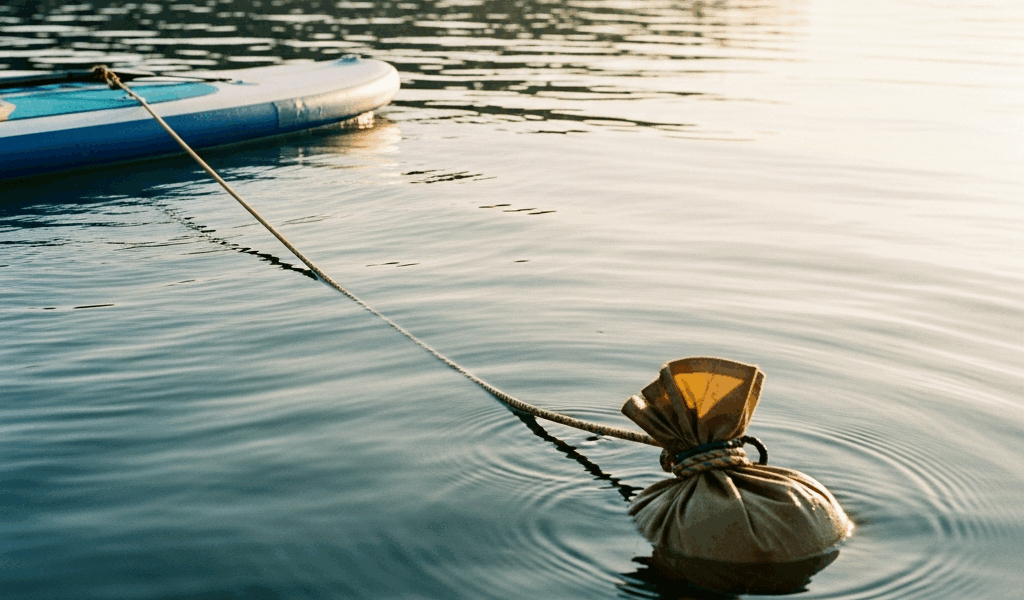
Fill the mesh bag two-thirds full of dry sand or pea gravel. Weight matters here—your anchor needs to hold against wind and current, not just sit uselessly on the bottom.
For paddleboards under 11 feet, 8-10 pounds of sand works fine on calm lakes. For longer boards or Puget Sound conditions, bump that to 12-15 pounds. The bag compresses slightly underwater, which is fine; the weight does the work, not the shape. Simple physics.
Tie the rope to the bag’s drawstring securely using a double-overhand knot. I’ve watched people tie single knots here and watch their anchor sink to the bottom when it slips. Don’t make my mistake.
Coil the rope on your board before deployment. Leave 3-4 feet of slack between you and the bag—this prevents the rope from tangling around your board or legs. When you’re ready to anchor, simply toss the bag over the side, let rope feed out naturally, and tie it off to your handle or pad eye with another carabiner. Takes maybe 20 seconds total.
When DIY Sand Anchors Fail
Sand bags work reliably on lake bottoms but struggle on rocky or heavily silted areas. Puget Sound’s variable bottom composition—sand, mud, scattered rocks—makes sand anchors unreliable. The bag can slide over silt or get wedged between rocks without holding.
Current stronger than 1.5 knots will sometimes drag even a 15-pound anchor if the bottom is slippery. Test this before relying on it in tidal waters—at least if you want to stay put.
Mushroom Anchors vs Grapnel Anchors for Paddleboards
Commercial anchors solve the reliability problem, but which one works best for Seattle conditions? I’ve tested both extensively over three seasons. The answer depends entirely on where you paddle.
Mushroom Anchors — Best for Lakes
These look exactly like what they sound like: a rounded cap on a shaft. Moorage boats use them constantly. They work through weight and suction rather than hooking into anything.
Mushroom anchors shine on soft bottoms—mud, silt, sand. Lake Union and Green Lake have plenty of that composition. You drop the anchor, it sinks, and suction keeps it planted. Very reliable. Won’t drag once it sets.
The downside: they’re genuinely heavy. A 10-pound mushroom anchor creates real fatigue carrying it paddleside. Retrieval can be surprisingly hard if suction holds strong. I’ve spent five minutes pulling hard on the rope trying to break suction on my 12-pound model—frustrating when you just want to leave.
Cost runs $40-70 depending on size. For Lake Union or Green Lake fishing trips, mushroom anchors are probably worth the investment. Deployment takes 20 seconds. Retrieval takes longer but always works.
Grapnel Anchors — Best for Rocky/Variable Bottoms
Grapnel anchors have multiple folding flukes that catch on rocks, debris, and uneven bottoms. Picture a four-armed claw. When you drop one, the flukes spread and hook into whatever surface exists below.
For Puget Sound’s rocky, variable bottom, grappels hold better than mushroom anchors. They work on hard surfaces where suction anchors struggle. Weight requirements drop too—a 5-pound grapnel often holds as well as an 8-pound mushroom in rocky terrain. That matters when you’re paddling distances.
The catch: fluke-type anchors need retrieval technique. If they really hook into something, simple pulling won’t free them. You might need to paddle directly over the anchor and pull straight up, or circle around to change the angle. I’ve lost one grapnel this way—got truly stuck on a submerged log near Vashon Island.
Cost ranges $30-60 for paddleboard-sized models. The Fortress FX-7 runs about $50 and gets solid reviews from Seattle paddleboarders. It weighs just over 2 pounds yet holds in moderate current—apparently a sweet spot for the Puget Sound crowd.
Head-to-Head for Seattle Waters
Green Lake or Lake Union? Mushroom anchor wins. You get suction holding, easy retrieval, and soft bottoms everywhere you’ll paddle.
Puget Sound, especially rocky areas near Bainbridge Island or the San Juan Islands? Grapnel anchor. The flukes grip rocks better, and lighter weight works for me while heavier mushrooms never work well for distance paddling.
Tether and Paddle Leash Alternatives
Sometimes anchoring to the bottom doesn’t solve your problem. Tethering to stationary objects offers backup or primary solutions depending on your situation.
Tethering to Fixed Objects
If you’re paddling near docks, trees overhanging the water, or buoys, a simple tether works. Use a 15-20 foot length of rope clipped from your board to the fixed object. This prevents drift entirely—your board goes nowhere.
The downside: you’re restricted to areas with fixed anchoring points. Lake Union has dock systems everywhere, so this works well. Green Lake’s shoreline is mostly public and open, so fewer options exist there.
Legal note: never tether to private docks without permission. Not worth the confrontation. Public buoys are fair game, but some are marked as restricted.
Paddle Float Anchor Hybrid
A paddle float is that inflatable bag you slide onto your paddle for self-rescue. Strapped to a paddle and deployed horizontally, it creates drag and resistance without anchoring to the bottom.
This doesn’t hold your board in fixed position like an anchor, but it slows drift dramatically. Wind still moves you, but much slower. Good for short breaks or when you’re fine with slow drifting as long as you stay generally in the same area.
I use this method on Green Lake when I’m just stretching for five minutes. Not a permanent solution, but better than nothing.
Combination Approach
Smart paddleboarders combine methods. Light sand anchor plus a tether to a nearby dock covers multiple scenarios. Wind shifts and tether fails? The anchor holds you. Anchor snags? The tether prevents serious drift. Redundancy matters.
This seems like overkill until you’re the person drifting toward the Ballard Locks with no recovery method.
Testing Your Anchor System
Never deploy an untested anchor system in real conditions. Calm water testing reveals problems before they become emergencies.
Safe Testing Protocol
Pick Green Lake on a calm day—wind under 5 knots, no boat traffic. Deploy your anchor in shallow water near shore (6-8 feet deep). Let out full rope length and hold your board steady for two minutes. Wind and minor current should be unable to move you.
Then test retrieval. It should take under one minute. If it takes longer or requires extreme effort, your system needs adjustment before real use.
After calm water success, graduate to mild wind conditions. Then tidal areas. Build confidence incrementally.
Signs Your Anchor Isn’t Holding
You’ll know immediately: the board drifts. Your rope will go slack rather than taut. Water depth affects this—if you’re in 15+ feet and the rope is only 50 feet long, you have limited tension anyway.
If your anchor drags in shallow water (under 10 feet), the anchor or weight is undersized for current conditions. Add weight or switch to a heavier commercial anchor. There’s no shame in upgrading.
When to Upgrade
Sand anchors work for years if maintained properly. Keep the bag intact and rope dry. Replace rope if it frays.
Once you’ve tested on different Seattle waters, you’ll develop preferences. I carry a sand anchor for Green Lake and switched to a grapnel for Puget Sound use. The $60 total investment paid off through reliable holding and reduced frustration. Worth every penny.
Drifting paddleboards are solvable problems. Spend 20 minutes this weekend assembling a sand anchor or ordering a commercial option. Your next paddling session will be immeasurably better.

Stay in the loop
Get the latest seattle paddleboard updates delivered to your inbox.