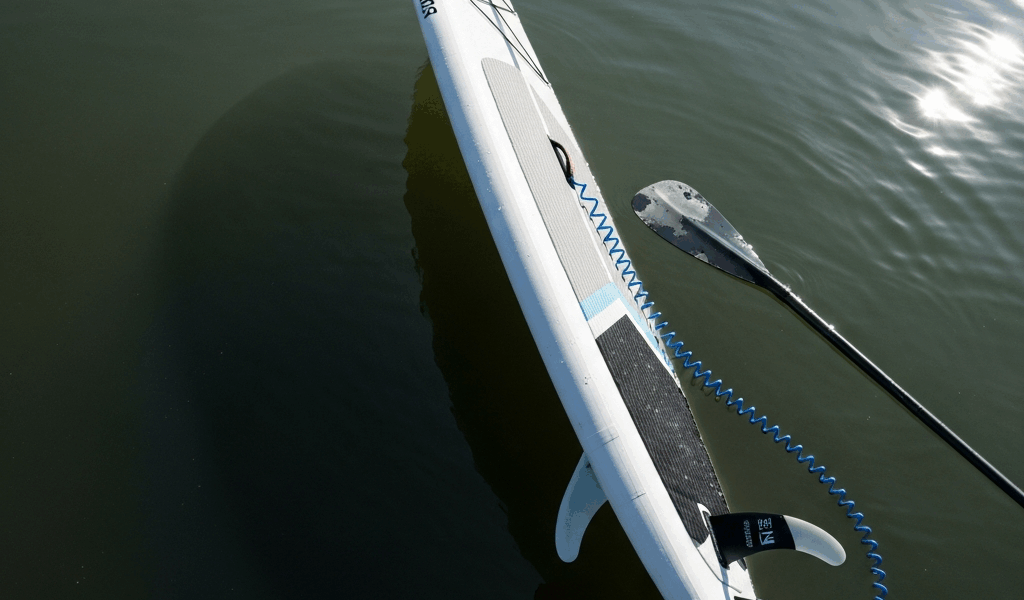
Why Your Paddleboard Leans to One Side
Paddleboarding has gotten complicated with all the gear advice and technique tutorials flying around. As someone who has spent years falling off boards in every condition imaginable, I learned everything there is to know about why these things refuse to go straight. Today, I will share it all with you.
Your board keeps leaning, and you’re convinced something snapped or warped. It hasn’t. Nine times out of ten the board itself is completely fine — the problem lives somewhere between your feet, your paddle technique, your fins, or the dry bag you threw on sideways that morning.
But what is board lean, exactly? In essence, it’s an imbalance of forces acting on the hull. But it’s much more than that — it’s usually a sign that something small and fixable has gone undiagnosed while you’ve been out there fighting the water instead of reading it.
The four root causes break down like this:
- Off-center or unbalanced foot position
- Uneven or overpowered paddle stroke
- Fin misalignment, damage, or asymmetrical setup
- Uneven weight distribution from gear or a slow leak in inflatable boards
Work through them in order. One will explain what you’re experiencing. So, without further ado, let’s dive in.
Check Your Foot Position First
Probably should have opened with this section, honestly. Stance is the answer more often than anything else on this list.
Your feet should sit roughly parallel to the stringer — that’s the centerline running nose to tail. Shift both feet two inches toward the left rail and your weight follows. The board responds by leaning away from that pressure. Simple physics, annoying consequences.
Even worse is standing too far back toward the tail. I’m apparently a chronic tail-stander, and my old 10’6″ Thurso Surf board showed it every single session — nose lifting, board tilting, paddling like I was trying to steer a canoe with a salad fork. My newer setup never does that when I stand correctly. Don’t make my mistake. Your feet need to straddle the carry handle — most boards put it right at center — or sit roughly 12 to 18 inches apart, centered between the midpoint and about one-third back.
Here’s how to reset your stance on the water:
- Stop paddling and stand completely still for a few seconds. Let the board settle.
- Look down at your feet. Are they equidistant from both rails?
- Shift your weight left, then right. The board should feel evenly balanced both directions.
- If you have a phone or camera nearby on shore, ask someone to film you paddling straight. Watch the footage — your stance and any weight shift become immediately obvious.
One trick worth trying: paddle out on a glassy morning and watch your shadow on the water. If your shadow leans, you’re leaning. Your reflection near the dock works just as well. Weirdly effective, costs nothing.
Fix Your Paddle Stroke if the Board Pulls Sideways
Feet are centered. Board still leans. Now we’re looking at your stroke.
An uneven paddle stroke drags the board sideways — reach farther with one arm, power one side harder, or angle the blade face slightly outward on one side and you’ll feel the board drift and tilt in that direction. It compounds fast. Twenty strokes in and you’re ten feet off your intended line wondering what happened.
The most common version of this: right-handed paddlers over-driving the right arm. The right blade plants deeper, pulls harder, and the board swings right. The lean follows. I paddled like this for two full summers before anyone pointed it out. That was embarrassing.
Test it by paddling 20 to 30 strokes across a calm stretch without correcting course. Watch where you end up. Consistent drift in one direction means your stroke is asymmetrical — not your fins, not your board.
To fix it:
- Keep your reach equal on both sides. The blade should enter the water at the same point relative to your foot position each stroke.
- Distribute power evenly. Same pull intensity left and right — consciously throttle back your dominant side until the drift stops.
- Watch your blade angle. Keep the paddle face square to your direction of travel, not twisted open.
- Switch sides every 10 strokes. This corrects drift in real time and builds symmetrical strength over a season.
That’s what makes paddle technique so endearing to us SUP paddlers — tiny adjustments create dramatic results. You don’t need a new board. You need ten minutes of honest self-observation.
Inspect and Adjust Your Fins
Fin problems are sneaky. A bent center fin or a loose side fin won’t stop you from paddling — it just quietly wrecks your tracking and makes everything feel slightly wrong, like a shopping cart with a bad wheel.
Walk through this checklist:
- Check that the center fin is fully seated in its box or slot. Most boards use a US Box system — the fin slides in and locks tight with a brass screw and plate. Push it firmly, snug the screw with a flathead or coin, and test for any wiggle. Any movement at all is too much.
- Look at the fin from the side. Straight, or bent near the base? A warped fin changes how water moves around it and creates asymmetrical pressure against the hull. You feel it as a persistent lean away from that side.
- Compare your side fins if your board has them. Stand back. Are they sitting at the same angle, same position? A side fin installed even slightly off pulls the board sideways on every stroke.
- Run your hand along the leading and trailing edges of each fin. Cracks, splits, or sharp areas mean impact damage — usually from rocks, shallow launches, or getting stepped on in the back of a truck.
While you won’t need a professional repair shop for most fin issues, you will need a handful of basic tools and possibly a replacement fin. A fiberglass center fin for a hardboard runs $40 to $120 depending on brand — Futures and FCS fins sit toward the higher end, generic US Box fins toward the lower. Side fins run $25 to $80 each. Glued-on fins for inflatables cost more, typically $150 to $300 for a quality replacement, but still far cheaper than a new board.
Bent fins on inflatable boards — the external plastic clip-in style — are almost always swappable without adhesive. I’ve replaced them in under five minutes with a single Phillips-head screwdriver. Easiest fix on this entire list.
When the Board Still Leans After All That
Stance is solid. Stroke is even. Fins check out clean. Now we look at the board itself and what’s on it.
First, your gear. A heavy dry bag or a 20-pound cooler strapped to one side shifts the board’s balance noticeably — more than most people expect. Center everything. Front-to-back matters too, not just side-to-side.
Inflatable boards sometimes develop slow leaks in a side chamber. Rare, but real — a pinhole from a stick or a microscopic seam defect lets one chamber lose pressure while the others stay firm. The softer side sinks slightly. The board leans toward it. Grab an air pump with a gauge and check PSI across all chambers. A properly inflated recreational board sits around 12 to 15 PSI. Any chamber reading more than 1 to 2 PSI below the others has a leak worth finding.
Hardboards can develop waterlogged foam rails from delamination — a crack or ding that wasn’t sealed lets water into the core, and one side gradually gets heavier. You’ll usually notice the board feels subtly different when you pick it up. Unfortunately, this one isn’t a quick fix. It typically requires professional repair or, in bad cases, replacement.
Board lean is almost always a technique or setup issue, not a factory defect. Frustrated by a board that seemed permanently broken, I once spent three weeks convinced I had a warped hull — turned out my center fin had a hairline crack at the base I’d missed on three separate inspections. Ran my thumb along it wrong every time. New fin, $55 from a local shop, problem gone. Work through the diagnosis in order and you’ll find it. Fix it, and your board will track straight.

Stay in the loop
Get the latest seattle paddleboard updates delivered to your inbox.