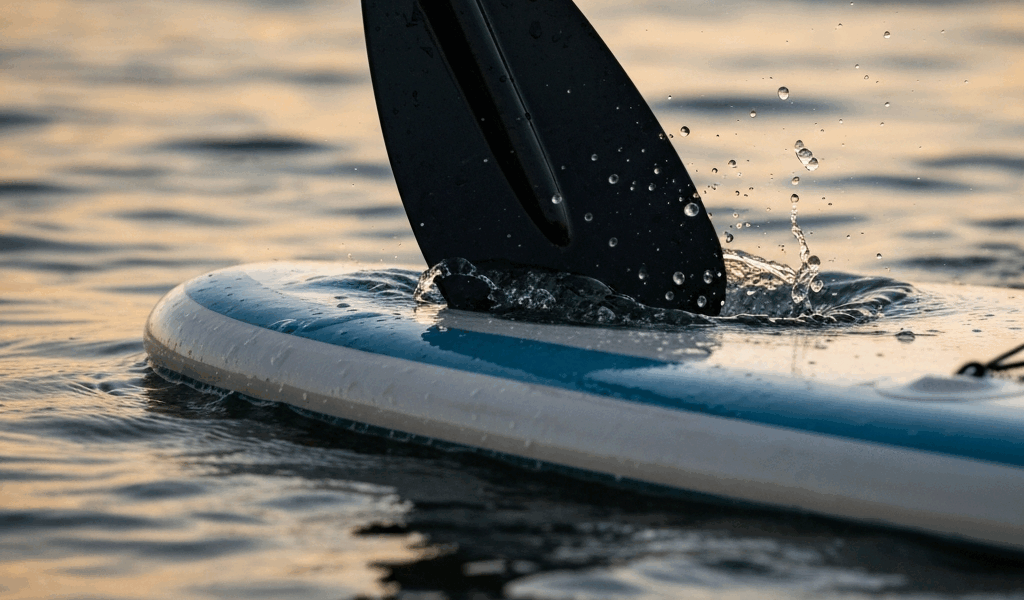
Why Your Paddle Keeps Hitting Your Board
Paddle blade hitting board has gotten complicated with all the conflicting advice flying around. I’ve watched paddleboarders spend entire seasons fighting this problem, and most never figure out why. After years of SUP fishing in varying conditions, I learned that this isn’t just annoying—it’s a precision killer. When your blade clips the rail or the deck, you lose momentum, you spook fish, and honestly, you look less confident than you actually are.
The issue always traces back to one of three things: your grip width is too narrow, your paddle is the wrong length, or your stroke technique needs recalibration. Sometimes it’s all three at once.
Here’s what matters for fishing—every time your blade hits the board, you’re burning energy inefficiently and creating vibration that travels straight through the water. Fish feel that. Your casting platform destabilizes. Your line of sight wavers. On a 2-hour morning session, those micro-disruptions compound into a completely wasted trip.
Before you drop $400 on a new paddle, run this diagnostic checklist. Stand on your board in shallow water. Take five strokes on your right side, five on your left. Does the blade hit during the catch phase (entry), the drive phase (power), or the exit? Does it hit the board itself or just the rail edge? Is the blade angling inward toward the board, or are you literally bringing the paddle shaft too close to your center line?
Write down which phase and which side. That single detail tells you almost everything you need to fix.
Check Your Paddle Blade Angle First
Probably should have opened with this section, honestly—grip and angle are the fastest things to correct, and most people never actually learn the mechanics.
Hold your paddle horizontally in front of you, hands roughly shoulder-width apart. The blade should face slightly away from your body, not perpendicular to the shaft. This is called a feathered blade offset—typically 30 to 45 degrees—and it’s designed to cut wind and reduce torque. Non-feathering blades sit square to the shaft.
For SUP fishing, non-feathering is actually better. Less wrist rotation. Simpler mechanics. One less variable to worry about.
Now grip the shaft. Your top hand—the one doing most of the steering—should sit about 4 to 6 inches from the blade. Your bottom hand belongs 18 to 24 inches down the shaft, closer to the water. If your bottom hand is closer to midshaft, you’re gripping too wide, and that’s the number one reason the blade tracks inward.
When you place the paddle blade in the water, your wrist should be neutral. Not bent back. Not flexed forward. Neutral. Imagine your forearm and hand forming a straight line from elbow to fingertips—that’s your entry position. If your wrist is bent forward as you catch the blade, your entire arm pulls the shaft inward, and boom, the blade hits board.
The catch phase is where this breaks down fastest. Reach forward, arms mostly straight, and place the blade in the water directly in front of your toes. Not in front of your knees. Not in front of your hips. Front of your toes. This positioning alone stops most blade-hitting-board problems because your reach is naturally wider, and the blade stays clear of the rails.
One thing I see constantly: people compensate for a bad catch by twisting their torso and rotating their shoulders. This is actually correct technique for moving fast, but it requires precision. If you’re not rotating your hips and shoulders together—moving as a unit—your arms compensate by dropping toward your body. The blade follows. It hits.
Practice the neutral wrist position on dry land first. Grab your paddle, stand in a split stance, and mime the stroke. Five strokes each side, very slowly. Feel where the blade should live in space relative to your centerline. That muscle memory transfers directly to the water.
Measure Your Paddle Length Against Your Board
There’s a formula, and it’s not the one most gear shops use.
Add 8 to 10 inches to your height in inches, then convert to feet and inches. So if you’re 5’10” (70 inches), your paddle should be roughly 78 to 80 inches—that’s 6’6″ to 6’8″. For reference, touring paddles often go 82 to 90 inches, but fishing boards demand stability and precision over speed. Shorter paddles keep you more compact and give you finer control over your casting platform.
Most people get this wrong because they buy a paddle designed for touring or racing, then wonder why it feels awkward on a fishing setup.
Here’s how to test your current paddle. Stand on your board in flat water. Grip the paddle at your normal width. Reach forward and fully submerge the blade. Your top hand should be roughly ear height, maybe slightly higher. If your top hand is above your head, your paddle is too long. If your elbow is bending significantly before the blade fully enters the water, your paddle is too short.
Wrong paddle length cascades into technique problems. Too-long paddles force you to widen your grip or bend your wrist to compensate. Too-short paddles force you to reach lower and pull the blade closer to your centerline because you can’t get full extension.
If your paddle measures 84 inches and you’re 5’8″, that’s almost certainly your problem. Before you buy a new one, know this: a $120 paddle that’s the right length beats a $400 paddle that’s wrong. I learned that the hard way after dropping cash on a fancy carbon-fiber 90-incher that I had to sell after two weeks.
Swap the paddle first. Adjust technique second. That’s the honest order.
Practice Drills to Fix Your Stroke
Once your grip and blade angle check out, these drills take 5 minutes each and fix the remaining problems.
The Narrow-Grip Drill
Intentionally grip narrower than normal—closer to 16 inches between your hands instead of 20. This forces your catch point further from your centerline, which means the blade literally can’t hit the board. Do 20 strokes at a moderate pace. Your arms might feel cramped. That’s the point. You’re teaching your body that the blade lives in a wider corridor. After this drill, return to your normal grip. The blade will feel impossibly far away. That’s good feedback.
The Figure-8 Drill
Paddle in a wide figure-8 pattern. This requires smooth arc strokes and forces you to rotate your hips and shoulders in sync with your arms. You can’t cheat and drop your blade inward because the turn geometry doesn’t allow it. Three minutes, one direction. Three minutes, the other direction. This builds synchronized rotation faster than any verbal cue.
The Slow-Motion Drill
Paddle at about one-third normal speed, emphasizing the catch phase. Exaggerate your reach. Place the blade deliberately far forward. Feel your torso rotate before your arms fully load. This is feel-development work—your nervous system learns where “correct” lives. Do 10 very slow strokes each side, pause, then speed up to normal pace. Often one slow set is enough to reset your pattern.
Watch for overcorrection signals. If you’re reaching so far forward that you’re losing balance, dial it back. If your blade is so far from your centerline that you’re twisting awkwardly, you’ve gone too wide. The fix should feel natural, not extreme.
When to Replace Your Paddle or Board
If you’ve verified your grip, confirmed your blade angle is neutral, practiced the drills, and measured your paddle length, and the blade still hits—you might be looking at a board design issue or genuinely need new equipment.
Some boards are just narrower or have rails that track inward at the center line. This is less common in fishing-specific boards, which tend to have wider platforms and more volume at the waterline. If your board is a converted touring or racing board, this might be the culprit.
On the paddle side, heavier blades (around 18 to 20 ounces) are actually better for all-day fishing. Less fatigue. More power per stroke. You need fewer strokes to cover distance. Lighter blades (under 14 ounces) are faster but can make technique sloppier because the feedback is reduced. I switched from a 12-ounce carbon blade to a 19-ounce composite blade, and my accuracy improved because I could feel the water pressure better and my stroke became more deliberate.
Stiffer shafts also help. A whippy blade absorbs energy and can deflect slightly during the drive phase, pushing the blade inward. A stiff shaft keeps the blade tracking true. For fishing, I’d rather have a stiffer shaft and slightly more blade weight than a light, fast setup that demands perfect technique every single stroke.
Here’s what I won’t tell you: buy the most expensive paddle. I will tell you this—once your technique is solid and your paddle is the right length, upgrading from a $200 aluminum or fiberglass paddle to a $350 composite paddle with a stiffer shaft does make a difference. On a 4-hour fishing day, that difference shows up as less fatigue and more consistent casting positions. That matters.
Start with diagnosis and drills. Those are free. Then measure and possibly swap to the right length—that’s $100 to $150. Only after you’ve exhausted those steps should you consider buying a premium new paddle or evaluating whether your board is the right tool for what you’re trying to do.

Stay in the loop
Get the latest seattle paddleboard updates delivered to your inbox.