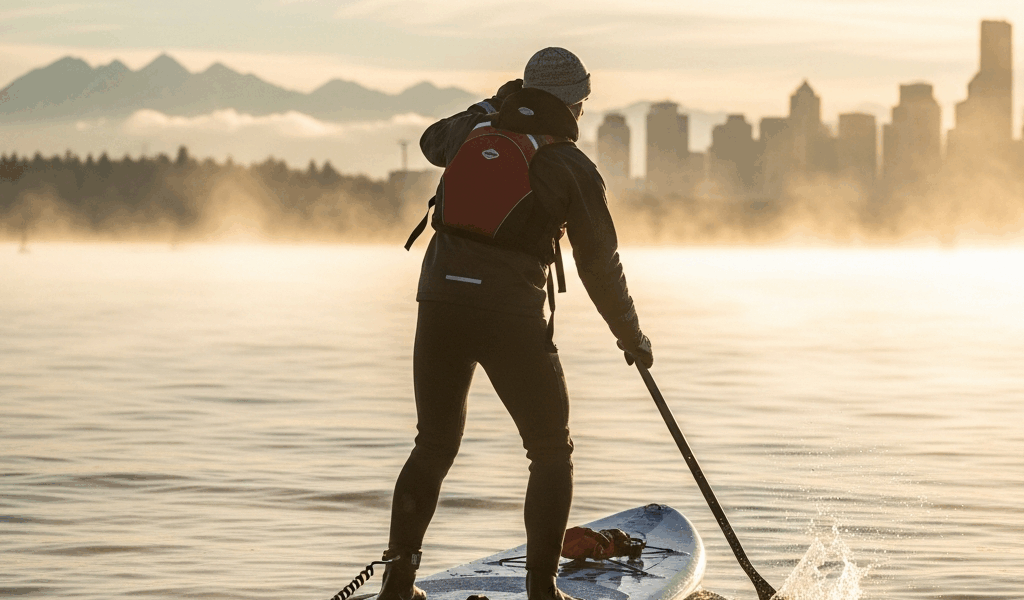
What to Wear Paddleboarding in Cold Water — A Puget Sound Guide
Dress for the Water, Not the Air
Puget Sound paddleboarding has gotten complicated with all the bad gear advice flying around — most of it written by people who learned SUP somewhere warm. As someone who took an unplanned swim near the Fremont Bridge in early May, I learned everything there is to know about cold-water immersion the hard way. It was 67 degrees and sunny that morning on Lake Union. I wore board shorts and a rashguard. The water was 51 degrees. I remember the gasp — that involuntary, full-body inhale — and thinking, with strange calm, that I was in actual trouble before I’d even oriented myself.
Don’t make my mistake.
This article includes affiliate links. We may earn a commission at no extra cost to you.
Cold shock is not a metaphor. In 50-degree water, your body fires an uncontrolled gasp reflex almost immediately — followed by hyperventilation, followed by rapid swimming failure. Research from the University of Victoria’s Thermal Protection Research Facility puts meaningful swimming incapacitation in 50°F water at under 10 minutes for an average adult. That’s not hypothermia. Hypothermia takes longer. The cold shock and the swimming failure get to you first.
A sunny May day in Seattle with 65-degree air and 52-degree water is not a warm-weather paddling day. It’s a cold-water paddling day wearing a warm-weather costume. That distinction — air temp versus water temp — is the whole ballgame out here. Everything else in this guide follows from it.
Puget Sound Water Temps — What You Are Actually Dealing With
Probably should have opened with this section, honestly. The numbers are what make Puget Sound categorically different from most places where SUP gear articles get written.
NOAA data from the Seattle Aquarium tide station and the Puget Sound Environmental Monitoring Program paint a consistent picture across multiple years:
- December through February: 43–48°F. Drysuit territory, full stop.
- March through May: 48–52°F. Still drysuit-appropriate — and a 4/3mm wetsuit is the absolute minimum if you won’t go that route.
- June through early July: 52–58°F. Surface temps nudge upward, but tidal mixing keeps deeper water cold. A 4/3mm wetsuit is still the honest answer here.
- July through August: 58–62°F. Peak summer. A 3/2mm wetsuit becomes defensible for most paddlers on shorter sessions.
- September through November: 52–58°F and dropping fast. People consistently underestimate fall. September feels like summer. The water doesn’t agree.
Compare this to La Jolla, California — average water temp in March sits around 60°F there, peaking above 70°F in summer. Gulf Coast Florida runs 70–80°F through most of the paddling season. A 3/2mm wetsuit that works perfectly in San Diego in March is not sufficient gear for Lake Union in May. A paddler who learned SUP in Florida and relocates to Seattle genuinely needs to relearn cold-water protocol from scratch — the gear that kept them comfortable there will not keep them safe here. That’s what makes Puget Sound so unforgiving to newcomers who don’t know what they’re walking into.
What to Wear by Temperature Range
55°F and Above — Warm Season Minimums
But what is Puget Sound’s “warm season”? In essence, it’s a narrow window — roughly mid-July through August. But it’s much more limited than most people expect. A 3/2mm full wetsuit — 3mm through the torso, 2mm at the limbs — handles sessions of moderate length during this stretch. The O’Neill Reactor-2 3/2mm runs around $130–$150 retail; the Rip Curl Flashbomb 3/2mm sits closer to $200. Both are solid. Some experienced paddlers get by with a thick 2mm neoprene top plus board shorts for very short, close-to-shore sessions — but that’s a choice made with open eyes, knowing any fall is still a cold-water event.
Neoprene booties are still worth wearing here. Wet feet on a cold board drain your warmth faster than most people expect. A 3mm round-toe bootie gives you decent board feel without sacrificing much insulation — small detail, real difference.
48–55°F — Spring and Early Summer, Most of Fall
This is where most Seattle-area paddlers spend most of their time. It’s also where gear choices matter most. The correct answer here is a 4/3mm full wetsuit — 4mm at the core, 3mm at the limbs. The Xcel Infiniti 4/3mm and the Patagonia R3 Yulex 4/3mm are both well-regarded for cold Pacific water. Budget $200–$350 for a quality suit in this range. A cheap 4/3mm with bad seam construction will flush cold water through the seams regularly — which defeats the whole point.
3mm neoprene gloves and 3–5mm neoprene booties are worth adding. Cold hands lose grip on a paddle faster than you’d think — the NRS Maverick gloves run about $35 and have enough dexterity for paddling without feeling like oven mitts. A neoprene hood might be the best option for extended sessions, as this temperature range requires serious heat retention. That is because you lose a significant amount of core warmth through your head and neck — more than most people account for when layering up.
Below 48°F — Winter and Early Spring
A drysuit. Not a heavier wetsuit. A drysuit.
The difference isn’t just about warmth — it’s about immersion physics. Wetsuits work by trapping a thin water layer against your skin and letting your body warm it. Below 48°F, that mechanism degrades, and the initial flood of cold water into a wetsuit during a fall triggers a cold shock response even through a 5mm or 6mm suit. A drysuit keeps you dry. Paired with proper base layers — merino wool or synthetic thermals, never cotton — it gives you a real survival window if you go in.
The NRS Axiom drysuit runs around $900. The Kokatat Meridian sits closer to $1,200. The cost is real. So is the water temperature in January on Commencement Bay. First, you should price out a drysuit rental for winter sessions — at least if you’re not ready to commit to a purchase — because the alternative is simply not paddling safely in those conditions.
PFD — Required, Not Optional, on Puget Sound
Washington State law requires paddlers on tidal waters — all of Puget Sound qualifies — to carry a Coast Guard-approved personal flotation device while paddling solo on a standup paddleboard. WAC 352-67-020 and RCW 88.12 govern this. Enforcement happens. The law says “accessible,” not necessarily worn — but in cold water, the gap between “clipped to your board” and “on your body” can matter more than any regulation implies.
Cold shock shuts down swimming ability fast. A paddler who falls into 52°F water without a PFD worn has a narrow window to self-rescue before their arms stop cooperating — and that window closes faster than people imagine until it’s happening to them. An inflatable PFD — the slim waistpack style that inflates on submersion or manual pull — eliminates most of the range-of-motion complaints paddlers raise. The NRS Zephyr ($130–$160) and the Mustang Survival MIT 100 ($120) are both popular in the local SUP community. They don’t restrict your paddle stroke. There is genuinely no good reason not to wear one.
On Lake Union specifically — freshwater, so different rules technically apply — you aren’t required by law to carry a PFD for SUP the same way. Doesn’t matter. The physics of cold water don’t change based on salinity.
The Ferry Wake Problem — Why Falling In Is More Likely Here
Frustrated by my own overconfidence near Coleman Dock during my second season on the Sound, I spent an embarrassing few minutes getting worked by Washington State Ferry wakes while fully convinced I had my balance dialed in. I did not. Wenatchee-class ferries displace 4,000+ tons — the wake they generate, especially in shallower near-dock water, arrives as irregular 18-to-24-inch waves with secondary reflections bouncing off the seawall behind you. Flat-water practice does not prepare you for this.
Most SUP falls happen on the second or third wave in a set, not the first. That’s what makes Puget Sound’s vessel traffic — ferry routes to Bainbridge, Bremerton, and Vashon; container ships in the main shipping lane; water taxis; tour boats — a genuine gear consideration, not just a navigation one. Paddling near any of these corridors means accepting that unplanned immersion is a realistic outcome on any given session.
This is why the cold-water gear question matters differently here than on a private lake in Eastern Washington. On calm, warm water, a fall is a nuisance. On Puget Sound in May in board shorts, a fall is a medical event. Gear your kit for the latter.
Budget Option — If You Are Not Ready for a Wetsuit
While you won’t need a full drysuit setup to get started, you will need a handful of specific layers if you’re paddling on a budget — and you need to be clear-eyed about what they do and don’t protect you from.
- Moisture-wicking base layer: Synthetic or merino wool, long-sleeved. Not cotton — wet cotton pulls heat from your body aggressively and offers nothing in return. The Smartwool Merino 150 long-sleeve runs about $80 and holds up well in wet conditions.
- Splash top or cag jacket: A paddling-specific splash top — not a hiking rain jacket — gives you wind and water resistance without trapping you. The NRS HydroSkin neoprene-faced top runs around $90 and bridges the gap toward actual wetsuit performance meaningfully.
- Quick-dry bottoms: Neoprene-blend tights — the Patagonia R1 Yulex tights run around $129 — are a real upgrade over plain board shorts for leg warmth. Apparently a lot of people skip this part and then wonder why their legs feel like ice blocks after 20 minutes.
This layered approach is survivable for short sessions in sheltered water when both air and water temps are above 55°F. It is not appropriate for open Puget Sound crossings, extended sessions, or water below 55°F. In 50-degree water wearing this kit, you have minutes — not the comfortable window a proper wetsuit provides. Use the budget system as a starting point, stay close to shore, and treat it as a temporary situation while you save toward a real 4/3mm. That’s what makes a proper wetsuit worth prioritizing — this is cold water, and the budget kit will remind you of that fact the moment you fall in.

Stay in the loop
Get the latest seattle paddleboard updates delivered to your inbox.