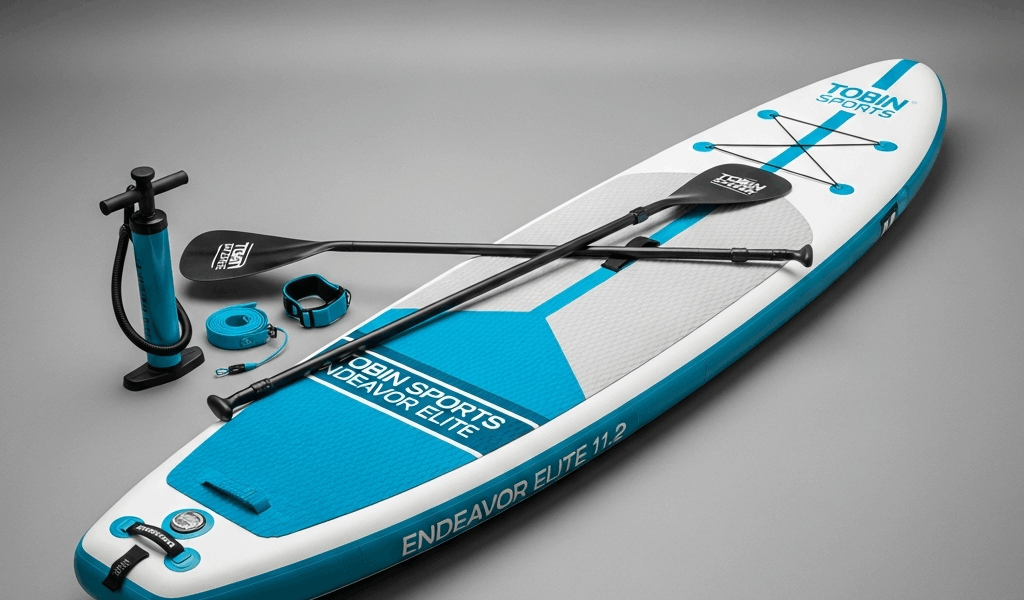
Tobin Sports Endeavor Elite 11.2 Review — Is This Costco Paddle Board Worth It?
Tobin Sports Endeavor Elite reviews have gotten complicated with all the TikTok unboxings and recycled product listings flying around. That’s genuinely all you’ll find out there right now. Nobody who paddles Puget Sound in October, gets rattled by ferry wake on Lake Union, or has hauled themselves back onto a board in 52-degree water has written a word about this thing. I have done all three of those things. As someone who paddles out of the PNW regularly and has tested boards in the $400–$1,100 range, I learned everything there is to know about this board after picking one up at the Issaquah Costco for $349.99 when it hit the floor this spring. Here’s what I actually found.
This article includes affiliate links. We may earn a commission at no extra cost to you.
Who Is the Tobin Sports Endeavor Elite Built For
Probably should have opened with this section, honestly. The Endeavor Elite is not a touring board. Not a race board. It’s not built for someone logging 30-session seasons or paddling technical whitewater — none of that is anywhere in the design brief for this thing.
The Costco buyer for this board is pretty specific. It’s the family that wants to try stand-up paddleboarding without dropping $700+ on an iRocker or Red Paddle Co. The dad who’s watched his neighbor strap a board to a roof rack for two summers and finally wants in. The couple renting a cabin at Lake Chelan who’d rather own gear than pay $45 an hour for rentals. The mom buying a gift that’ll realistically see six to ten sessions per summer — and that’s fine.
That buyer exists in enormous numbers. And for that buyer? This board is a genuinely reasonable option — if expectations are calibrated correctly going in. But what is the Endeavor Elite, really? In essence, it’s a recreational all-around inflatable SUP. But it’s much more than that to the right person — it’s a low-stakes entry point into a sport that can genuinely hook people. I want to be fair to it in that framing rather than holding it next to a $900 board and calling it a failure.
First Impressions — Unboxing and Setup
The bag is better than I expected. Seriously. Most budget iSUP bags feel like glorified garbage sacks with shoulder straps — the Tobin carry bag has actual padding on the back panel, two carry handles, and enough internal organization to fit the board, the pump, the paddle, the fin, and the leash without the whole thing becoming a stuffed burrito. I’ve used worse bags from brands charging twice the price.
The included pump is the PowerGrip Sport dual-action electric pump — and I need to be specific here, because pump quality is the single most common failure point in budget board packages. The PowerGrip Sport runs off your car’s 12V DC outlet. It got the board from flat to 15 PSI in approximately 12 minutes in 58-degree ambient air. Acceptable. Not fast, but acceptable.
Here’s the thing nobody mentions: the pump does not auto-shutoff at a pressure you set. You’re watching the gauge manually. I missed my target once and hit 16.5 PSI before I caught it — the board handled it fine since the recommended max is 15 PSI, but that’s annoying coming from a pump described as featuring “advanced pressure control.” Don’t make my mistake. Watch the gauge the whole time.
The paddle is three-piece aluminum with a plastic blade. Adjusts from roughly 68 to 84 inches, which covers most adult heights. Weight is around 2.2 lbs — heavier than carbon fiber, obviously, but perfectly usable for casual sessions. Blade shape is a basic teardrop. Nothing inspiring, nothing offensive.
The fin system uses a single US-box fin with a tool-required installation — a standard 9-inch center fin. Straightforward. I’ve dealt with worse proprietary fin systems on boards from more recognizable brands. The setup instructions in the box are genuinely clear, and the QR code links to a video that actually covers common inflation mistakes. Small thing, but it matters for first-timers who’ve never touched an inflatable SUP.
On the Water — Stability, Tracking, and Maneuverability
The 11.2 x 32-inch dimensions are the most important spec on this board. Thirty-two inches wide. That one inch over the Body Glove Performer’s 31-inch width sounds meaningless until you’re standing on a board in chop and your brain is screaming at your feet to stop moving.
Paddling through ferry wake on Lake Union on a Tuesday morning last May, I kept my feet planted and stayed dry through three sets of wake that would have had me scrambling on a narrower platform. That’s the honest answer on stability — it’s genuinely stable for its price class. Beginners who are nervous about falling will find the extra width reassuring. Intermediate paddlers who want to throw a turn or practice crossbow strokes will find it a little sluggish in response. That’s the tradeoff with width. This board doesn’t carve. It plods, pleasantly. That’s what makes the Endeavor Elite endearing to us recreational paddlers who just want to get out on the water without a disaster.
Tracking is average. Using the included 9-inch fin at 15 PSI, I was correcting every three to four strokes in flat water — typical for an all-around board in this dimension range. Not poor, just not the straight-line efficiency you get from a touring shape with a longer waterline. For recreational paddles under two miles, it’s a non-issue. Push past that and you’ll feel it in your paddle cadence.
Cold water falls are the real test in the PNW. If you fall off this board in Puget Sound in any month outside of July or August, you’re entering water between 48 and 56 degrees Fahrenheit — not a casual swim. The full EVA foam deck pad with its grooved diamond pattern runs the length of the board and provides reasonable grip even when soaking wet. Getting back on was straightforward. The board doesn’t sink under your weight on remount the way softer boards do when they’re under-pressurized. At 15 PSI, this thing feels close to rigid. Drop to 10 PSI and try to remount — you’ll immediately understand why proper inflation matters.
Build Quality — Is Tritech Construction Actually Sturdy
Tobin calls this “Tritech triple-layer reinforcement” construction with a center stringer. In practice — a PVC drop-stitch core with additional laminate layers on the deck and hull, plus a longitudinal stringer running the length of the board to cut down on flex. It’s a step above the single-layer drop-stitch boards crowding similar price points on Amazon, but it’s not the military-grade fusion laminate you see in Red Paddle Co or Starboard iGO boards.
At 15 PSI, flex is minimal. I did a stomp test at the center of the board with my full body weight — 188 lbs — and got maybe half an inch of give. Acceptable rigidity for this category. At 10 PSI, that same stomp produced nearly two inches of deflection and the board felt noticeably soft underfoot. The difference between 10 and 15 PSI on this board is not subtle. Inflate it fully. Every time.
I’ve paddled single-layer drop-stitch boards at $299–$329 on Amazon with similar dimensions — they measure the same but feel noticeably less rigid at equal pressure. The Tritech construction does appear to add measurable stiffness. I can’t speak to five seasons of heavy use — I’ve had this board for one season — but after 14 sessions including rocky beach launches at Deception Pass State Park, there’s no visible delamination, no seam bubbling, and no pressure loss between inflations beyond the normal temperature-related fluctuation.
Tobin Sports Endeavor vs Body Glove Performer — Both at Costco
Both boards have appeared at Costco locations across the Pacific Northwest in the same season, so the comparison is worth a few minutes of your time. The Body Glove Performer 11′ is typically priced within $20–30 of the Endeavor Elite depending on when you catch it on the floor.
Width difference: 32 inches versus 31 inches. One inch. For true beginners, the Endeavor Elite’s extra width is a real stability advantage. The Body Glove Performer tracks slightly better — that matters if the buyer has any experience and cares more about efficiency than stability.
Pump quality on the Body Glove package has been a documented weak point — user reviews on Costco’s own site mention pump failures within one season. The PowerGrip Sport included with the Endeavor Elite feels more robust, though I only have one season of data on mine. The fin systems differ too — the Body Glove Performer uses a snap-in fin that installs tool-free but feels less secure than the US-box fin on the Endeavor Elite.
Both boards are reasonable choices. I’d give the Endeavor Elite a slight edge for complete beginners and hand the Body Glove Performer a slight edge for buyers who’ve paddled before and want marginally better straight-line performance.
Is the Tobin Sports Endeavor Elite Worth Buying
Yes — for a specific buyer. Here’s the clear version.
Buy this board if:
- You’re a complete beginner or buying for a family that’s never owned a SUP
- Your realistic usage is 5–15 sessions per summer on calm lakes, slow rivers, or protected bays
- Your budget ceiling is around $400 and you’re not ready to spend $700+ on a brand like iRocker or Atoll
- You want an all-inclusive package — pump, paddle, bag, fin, leash — without sourcing accessories separately
- You prioritize stability over performance, specifically that 32-inch width for nervous new paddlers
Skip this board if:
- You already paddle regularly and are looking for a board you’ll use more than 20 sessions per season
- You want to tour, race, or paddle open water beyond protected conditions
- You’re 220+ lbs and planning to paddle in significant chop — the 275 lb weight limit is listed, but rigidity under heavier loads in moving water is a legitimate consideration
- You want a board that holds resale value in two to three years — budget Costco boards don’t
An iSUP might be the best option for first-timers, as paddleboarding requires accessible gear that won’t financially punish you for quitting. That is because the sport has a real attrition rate — people try it twice and move on, and a $349 loss stings a whole lot less than a $900 one.
The mistake I see people make — and I’ve made a version of it myself with an earlier budget board purchase — is buying something at this price point with the vague plan to “upgrade later when I get serious,” then getting serious faster than expected and resenting the interim board. If you already know you’ll be paddling twice a week by August, skip this and put your money toward an entry-level iRocker or a used Atoll 11′. The Endeavor Elite is not built for that kind of commitment.
But if you’re the Lake Chelan cabin family — the first-time buyer, the person genuinely unsure whether SUP is going to stick — this board does its job honestly, at a price that doesn’t sting if it lives in your garage after October. That’s not faint praise. That’s exactly what this category of board is supposed to do.



Stay in the loop
Get the latest seattle paddleboard updates delivered to your inbox.