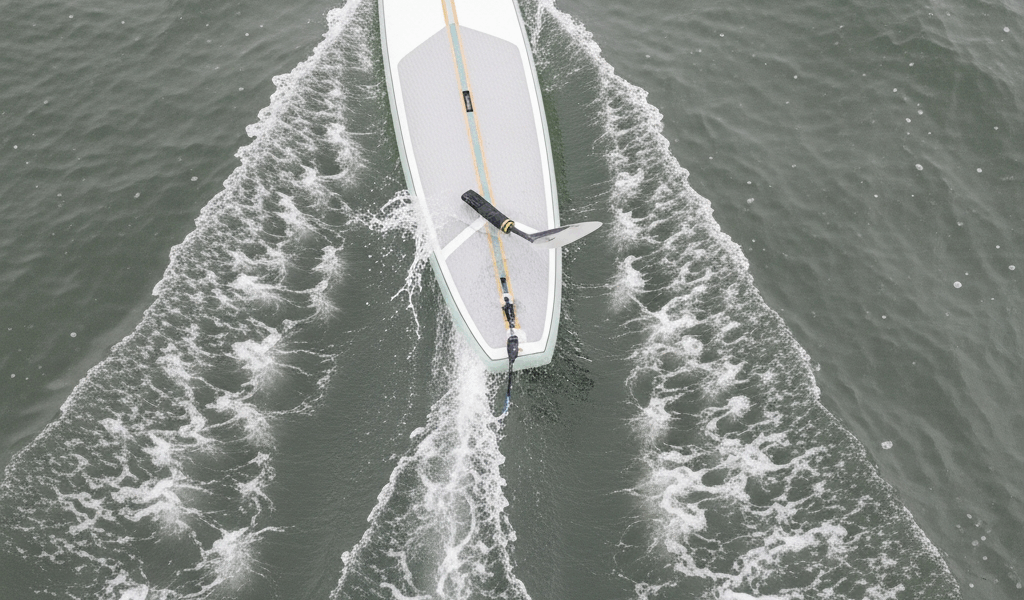
Why Your Paddleboard Keeps Sliding Backward When Paddling — And How to Fix It
Paddleboarding has gotten complicated with all the gear advice and technique noise flying around. As someone who’s been on the water around Seattle for eight years, I learned everything there is to know about why boards slide backward instead of forward. Today, I will share it all with you.
You’re putting in the work. Arms burning. And somehow the person next to you — barely trying, it seems — is gliding past while you’re drifting the wrong direction entirely. I watched this exact thing frustrate new paddlers at Green Lake, Lake Union, and Rattlesnake Lake more times than I can count. The good news? It’s almost never the board. It’s almost always one of three things you can fix in under ten minutes.
Why You Slide Backward in the First Place
But what causes backward sliding? In essence, it’s a momentum problem. But it’s much more than that.
Three specific culprits kill forward movement. Your paddle blade is probably angled wrong — most beginners drag it through the water like they’re stirring a pot of soup instead of actually driving it backward. Or you’re standing too far back on the board, which lifts the nose and turns it into a speed brake. Or your fin isn’t doing its job — loose, missing, or under-inflated if you’re riding an inflatable.
That’s it. Everything else is downstream from one of those three.
Check Your Paddle Angle Before Anything Else
Probably should have opened with this section, honestly.
Frustrated by what seemed like pure physical weakness, I paddled wrong for my first three months on the water — using a blade angle that was fighting me the entire time. I thought I needed more gym time. Turns out I just needed to tilt the paddle shaft forward by about 10 to 15 degrees.
Most beginners hold the paddle almost perfectly perpendicular to the water — straight up and down — while pulling through a stroke. The blade face ends up pointing backward, parallel to the board’s centerline. Looks reasonable. Completely wrong.
Your blade should be pitched slightly away from your body at the top of the stroke. Think about driving a stake deeper into the ground rather than yanking a rope. The blade’s leading edge — the one that enters the water first — should sit just slightly higher than the trailing edge. When you get this right, the blade catches water and converts arm effort into actual board movement instead of just churning water horizontally.
Once I fixed the angle — literally just tilting the shaft forward a few degrees — my speed jumped by almost half. No fitness change whatsoever. Pure geometry.
Don’t make my mistake. Before your next session, grab the paddle, hold it at the top of a stroke position, and look at the blade face. If it’s facing straight back, rotate the shaft forward until the blade tips slightly away from your body. Practice five strokes on land. You’ll feel the difference immediately.
Shift Your Feet Forward on the Board
Foot placement is basically invisible to new paddlers. You step on, you start paddling, you assume the board handles the rest. It doesn’t.
Your feet need to be centered — roughly parallel to the carry handle, or just a few inches behind it if your board has a clearly marked one. Not back near the tail. Not crowding the nose. Dead center, shoulder-width apart.
Standing too far back lifts the nose off the water. A raised nose creates drag — real, measurable drag. On flat water at Green Lake, you might lose a few percent of your speed and barely notice. On Seattle chop, which is honestly most of the time, that cost multiplies fast. Wind chop, boat wake, current breaks — all of it gets worse when your nose is already up before conditions even hit you.
The fix is immediate and physical. Move your feet forward until your toes sit roughly beneath your shoulders, centered over the handle. You’ll feel the nose drop. The board flattens out. Your glide distance per stroke — the free distance you travel after each pull — increases noticeably.
I’m apparently sensitive to even small position shifts and moving forward just four inches works for me while standing even slightly back never does. If you’re renting from somewhere like Agua Verde or Green Lake Paddle, just ask the rental attendant to watch your stance for ten seconds before you launch. Most shops do this for free. They see the problem constantly.
Check Your Fin Setup Is Correct
A loose or missing fin is the fastest way to turn a functional board into a drift toy. That’s what makes fin security endearing to us paddlers who’ve learned this lesson the hard way.
Most recreational SUP boards run either a single-fin system or a three-fin setup — one center fin plus two smaller side fins. The center fin handles roughly 90 percent of the tracking work. Lose that, and the board won’t hold a straight line. It’ll slide sideways or spin backward under any real load.
Inflatable boards with snap-in fins are especially vulnerable. I’ve personally watched a center fin pop loose at the halfway point of a two-hour session — the paddler had no idea. The board got progressively harder to control, so they assumed fatigue. They weren’t tired. The fin had simply unseated itself somewhere around the one-hour mark.
Before your next session, flip the board and find the center fin box — the slot running front-to-back along the middle of the hull. Push the fin in firmly until you hear or feel the click. It should be completely immovable when seated correctly. On hard boards, check the retaining bolt or screw. On inflatables, confirm the fin base is fully inside the valve channel, not just partially inserted.
Three-fin systems: all three fins matter, though the side fins mostly handle stability rather than tracking. Tighten everything. A loose side fin costs you more than you’d expect.
While you won’t need a full toolkit, you will need a handful of basic items — specifically a fin key or a flathead screwdriver depending on your board’s fin system, and a pressure gauge if you’re on an inflatable. A $20 gauge from REI takes about 30 seconds to use and solves roughly half of all “board performance” complaints I’ve ever seen. Under-inflated boards — anything below the manufacturer’s recommended PSI, usually printed on the board itself — sit lower in the water and create constant drag throughout the entire session.
Quick Fix Checklist Before Your Next Session
- Paddle angle: Tilt the blade away from your body at the top of each stroke. Practice five strokes on land first. The blade’s top edge leads. Not optional.
- Foot position: Stand centered on the board, feet shoulder-width apart, directly over the handle or just barely behind it. Not near the tail — ever.
- Fin security: Pull the board out and push the center fin in until it clicks or locks. Check all three fins if you have a three-fin setup. Nothing should wiggle.
- Board inflation: Inflatable boards need a pressure check every single session. Use a gauge. Match the spec on the board. Underinflated boards drag from the moment you launch.
- Water conditions: Seattle chop amplifies every technique mistake. Don’t assume the board is broken — run this checklist first, every time.
So, without further ado, run this checklist before you head out — and your backward-sliding problem should disappear. Most of the time, it’s not the board. It’s one of these four things, and every single one of them takes less time to fix than it took you to read this.


Stay in the loop
Get the latest seattle paddleboard updates delivered to your inbox.