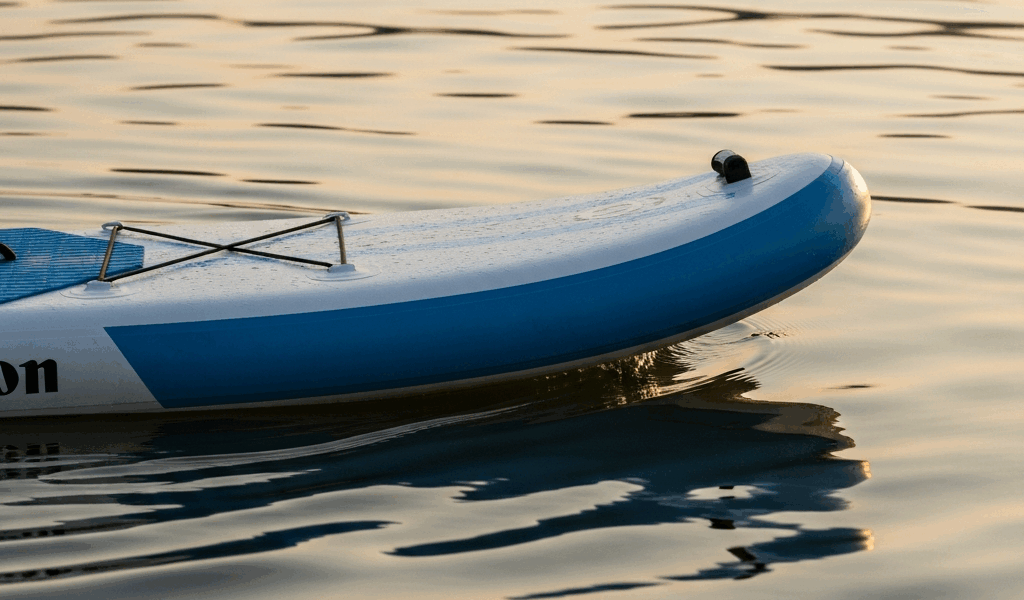
Why Your Paddleboard Nose Is Going Under
Paddleboarding has gotten complicated with all the conflicting advice flying around. Everyone’s got a hot take on stance, on gear, on board selection — and meanwhile you’re out there on the water watching your nose sink like it owes someone money.
As someone who spent three soggy seasons troubleshooting a nose-diving SUP on Puget Sound, I learned everything there is to know about why this happens. Today, I will share it all with you.
Here’s the short version: four separate things can cause nose-diving. Most of them have nothing to do with your stance. You might be standing in the wrong spot. Your board might not have enough volume for your body weight plus gear. Your inflatable could be running low on PSI. Or your cargo placement and paddle technique are quietly working against you. That’s what makes this problem so frustrating — it rarely has one clean answer.
So, without further ado, let’s dive in. Figuratively, this time.
Fix 1 — Move Your Feet Back on the Board
Start here. This is the fastest diagnosis you can run, and it solves the problem roughly forty percent of the time.
Most paddleboards have a carry handle molded into the deck somewhere near the middle. A lot of newer paddlers treat that handle like a “stand here” marker. It feels right. It feels centered. It is not where your feet belong.
Six to twelve inches behind that handle — that’s your zone. On a nine-foot board, I stand about eighteen inches from the tail. On my ten-footer, closer to twenty. The sweet spot is wherever the board sits flattest in the water without rocking when you shift your weight side to side. You’ll feel it when you find it.
Field test: stand where you normally stand, watch the nose, then shuffle back six inches. Does it lift? Does the board calm down? If yes — that’s your answer. You found it. Move back and stay there.
I learned this the stupid way on a choppy morning in Elliott Bay. Cold hands. Puget Sound chop coming through every thirty seconds. My brain was focused entirely on not falling in, and without realizing it, I kept creeping forward on the board — bracing myself, basically. The nose buried itself over and over. Fifteen minutes of consciously moving back fixed it completely. Don’t make my mistake.
Fix 2 — Check If Your Board Has Enough Volume
Probably should have opened with this section, honestly. But here we are.
Every paddler has a minimum volume requirement. Take your body weight in pounds, multiply it by 1.1 to 1.4 — that’s roughly how many liters of board volume you need on flat water, just for yourself, carrying nothing. I weigh 175 pounds. My bare minimum works out to somewhere between 193 and 245 liters under perfect conditions.
Now add gear. A dry bag with a phone and some snacks runs maybe five pounds. A wetsuit and hood for cold Pacific Northwest water — that’s another fifteen. Small anchor or drift gear adds ten more. Suddenly I’m hauling an extra thirty pounds, which pushes my minimum requirement up to around 228 to 287 liters. That’s before I even touch the paddle.
But what is board volume, exactly? In essence, it’s a measure of how much water the board displaces — which determines how much weight it can support before sitting low and nose-diving. But it’s much more than that. It also affects stability, speed, and how the board handles chop. Manufacturer specs are usually stamped near the tail or printed inside the valve area. Check yours.
I own a 180-liter board that felt genuinely great during summer paddles. Come October — layered up for 52-degree water, GoPro clipped to the front D-ring, small dry bag on the bow bungee — it started burying its nose constantly. My stance hadn’t changed. My board had. The volume that worked in July stopped working the moment I added cold-weather gear to the equation.
Fix 3 — Inflate Your iSUP to the Right PSI
An underinflated board is the second most common culprit I see, and it’s almost embarrassingly fixable.
Here’s the geometry: when the tail flexes under your weight, it sags downward. When the tail sags, the nose rotates forward and down. That’s it. That’s the whole problem. Physics doesn’t care how good your stance is.
A lot of paddlers pump to ten or twelve PSI and call it done. That’s not enough. Most quality iSUPs — a Bluefin Cruise 10’8″, an NRS Mayra, a SIC Maui Air Glide — are designed to run at 15 PSI. Some models allow up to 18. Higher pressure stiffens the entire structure and keeps the tail from flexing under load.
Get your pump — electric if you have one, manual if you don’t — and go to 15 PSI minimum. Once you’re there, press down on the center of the board with firm hand pressure. If you can push it down more than about an inch, you’re still under-pressurized. A properly inflated iSUP feels stiff and slightly springy underfoot. Not squishy. Not soft. Stiff.
I’m apparently sensitive to temperature drop and my Bluefin works best when I inflate it slightly above 15 PSI, while my old pump never actually reached the pressure it claimed on the gauge. One small wrinkle worth knowing: if you inflate on a 60-degree beach and then spend two hours on 52-degree water, the air inside contracts. You might start at 15 PSI and drift down to 13 by noon. Check the valve midway through your paddle if the nose starts misbehaving again.
If your pump won’t push past ten PSI no matter what you do — that’s a separate pump problem, not a board problem. Worth troubleshooting the pump before you blame the SUP.
Fix 4 — Rebalance Your Gear and Adjust Your Paddle Stroke
Frustrated by a nose that kept diving even after checking everything above, I went through all three fixes on a gray Tuesday morning at Alki Beach — correct stance, verified 240-liter volume rating, 15 PSI in the tube — and still watched the nose go under in choppy water.
The culprit was a dry bag clipped to my front bungee. Five pounds, sitting maybe eight inches from the nose tip. In rough water, that small forward load was enough to pull the bow down incrementally with every wave. Moving it to the center bungee — right behind my feet — removed about thirty percent of the problem immediately. That’s what makes weight distribution so endearing to us gear-heavy paddlers: it matters way more than it should.
If you’re carrying anything on the bow, move it to center or rear. Heavier items belong behind your feet, not in front of them. Simple rule, easy to forget when you’re loading up quickly on the beach.
Then look at your stroke. An aggressive forward lean — especially when you’re bracing into chop — shifts your center of gravity and can actively push the nose under. Stay upright. Keep your torso vertical. Drive the paddle down and back with a relatively straight arm rather than a hunched, rolled shoulder. The blade should enter the water as close to vertical as possible. An angled entry pulls the nose forward with every stroke.
So: feet back, volume confirmed, 15 PSI in the tube, gear moved to center, stroke cleaned up — and the board still nose-dives?
Your board is undersized for your load. Time to size up.

Stay in the loop
Get the latest seattle paddleboard updates delivered to your inbox.