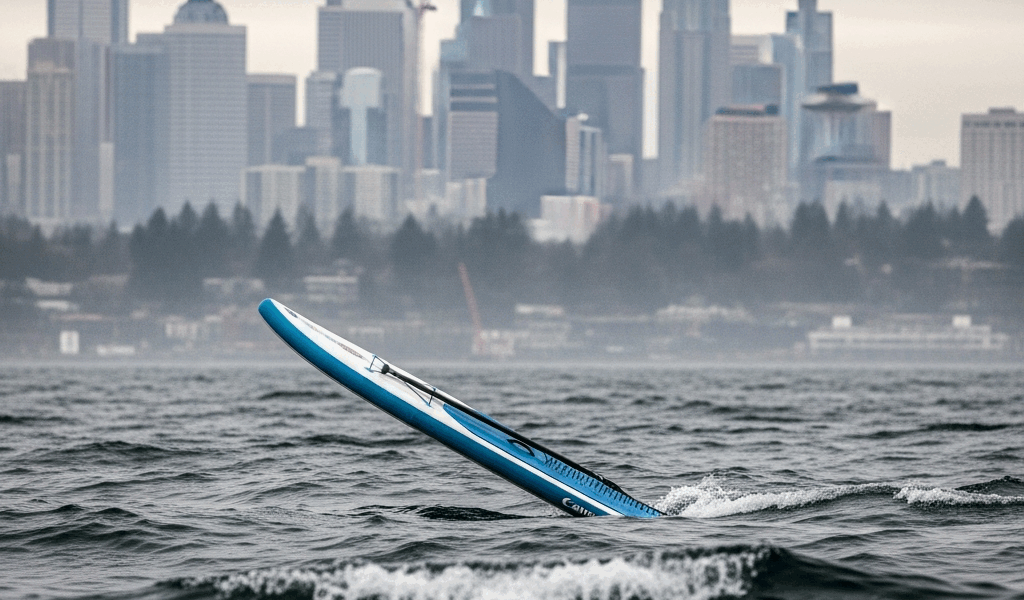
Why Wind Pushes You Sideways on a Paddleboard
Paddleboarding in wind has gotten complicated with all the conflicting advice flying around. So let me just explain what’s actually happening to your board.
Your paddleboard is, in physical terms, a large flat sail resting on water. A board 10 feet long and 32 inches wide presents an enormous surface area for wind to grab. Inflatables make this worse — their rails sit higher above the waterline, catching even more air pressure than a hardboard of identical dimensions. Your fin helps you track forward in a straight line, sure, but it simply cannot overcome a sustained sideways force once the breeze climbs past “light.”
Inflatables drift more than hardboards. Higher rail profiles. More volume pushed out toward the edges. A 2024 Bluefin Carbon 11-footer sits noticeably lower on the water than a comparably sized inflatable, which is exactly why hardboard paddlers on Puget Sound complain less about sideways drift on gusty afternoons.
But what is the real problem here? In essence, it’s the combination of an undersized fin, poor weight distribution, and sloppy paddle strokes interacting with the wind. But it’s much more than just “wind bad.” Fix those three things first. The wind becomes manageable.
Adjust Your Stance and Foot Position First
This is the free fix. Probably should have opened with this section, honestly.
Most paddlers stand too upright and too far back on the deck. Square shoulders, parallel feet, perfectly centered — you’re presenting maximum surface area to the wind. Shift your weight forward instead. Lower your center of gravity just slightly. The nose dips into the water, and suddenly you’ve reduced the amount of board catching wind above the waterline. Simple physics.
Your feet should be:
- About shoulder-width apart
- Positioned so your back foot lands just behind the carry handle — not on top of it
- Angled slightly, not squared off like you’re standing at attention
One foot slightly forward, one slightly back, shoulders rotated open. It’s almost a surf stance, except the water isn’t moving under you. This lets you lean into gusts without toppling sideways and naturally cuts the wind profile your body presents.
I learned this the hard way on Lake Union during a March paddle when wind came off the Cascades with almost zero warning. Standing straight up, feet parallel, looking like I was waiting for a bus. Within two minutes I’d drifted 60 feet toward the Wallingford side while fighting every inch of it. Shifted into a staggered stance. Drift cut in half immediately. No new gear, no adjustment to anything except where I put my feet.
Don’t make my mistake. Practice this on a calm day first so you actually know what proper forward weight distribution feels like before wind is screaming at you.
Change Your Paddle Technique to Counter the Drift
Paddling harder on your downwind side doesn’t fix wind drift. It just exhausts you in about four minutes. I’ve watched it happen to dozens of people at the Westlake put-in.
Use these techniques instead:
Sweep Strokes on the Windward Side
Add a wide, curved stroke on the side facing the wind. Angle your paddle outward and pull it back in an arc rather than straight through. It acts like a rudder, corrects your line, and doesn’t burn nearly the energy that frantic forward strokes do. Two or three forward strokes, then one sweep on the windward side. That’s the rhythm.
The J-Stroke
Canoeists have used this for centuries — it works on SUPs too. At the end of your forward stroke, twist your wrist so the blade faces outward, then push out slightly. Steers you without wasting energy. Feels genuinely awkward the first dozen times, then becomes muscle memory. Worth the learning curve.
Paddle as a Rudder During the Glide
Between strokes, while momentum carries you forward, hold your paddle vertical in the water on the downwind side. The blade catches water and functions as a small, passive rudder. Almost zero effort. Surprisingly effective at keeping you tracking straight.
The mistake I see constantly: people assume paddling faster fixes drift. It doesn’t — speed actually makes it worse. A drifting board at 4 mph is annoying. That same board drifting at 5 mph becomes genuinely hard to manage. Slow down, use technique, stay in control.
Check Your Fin Setup Before Blaming the Wind
A missing, loose, or undersized fin is often the actual culprit. That’s what makes fin setup one of those things endearing to us gear-obsessed paddlers — such a small component, such an outsized effect.
Walk through this checklist:
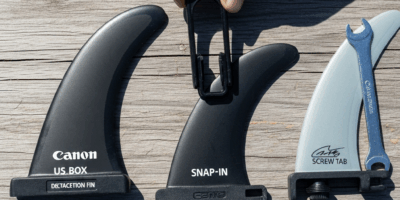
- Is your fin loose? Pull it out completely. You should need moderate force to remove it. If it slides free easily, the box or fin itself is worn. Tighten the screw if your board uses a screw-in system. Replace the fin if it’s damaged — a cracked fin base costs you tracking on every single stroke.
- Is the fin the right size? Flat-water inflatables often ship from the factory with 7-inch fins. Fine for glassy lake mornings. Open water in wind demands at least an 8-inch or 9-inch fin, sometimes larger. Lake Union and Puget Sound aren’t flat water. If you’re paddling there regularly, upgrade your fin — full stop.
- Is one fin enough? A single center fin beats no fin, obviously. But three fins in a thruster setup, or a center fin paired with side fins, provides dramatically more resistance to sideways drift. Many modern inflatables support multiple fin boxes. Check yours.
Some boards ship with undersized fins as a cost-cutting measure. A big-box retailer inflatable SUP might come with a 6-inch fin. That’s roughly 30% too small for windy open water. A 9-inch FCS fin runs $40–$60 — a measurable difference for a pretty modest investment.
I’m apparently a twice-a-week paddler, and checking fin tightness monthly works for me while skipping that check never does. Vibration from water movement loosens fins gradually. It’s a slow process you won’t notice until you’re already drifting.
When to Get Off the Water and What to Do Instead
Be honest with yourself here. Sustained wind above 15 mph is genuinely dangerous on a SUP — not just annoying, not just inconvenient. Dangerous. That’s the threshold where even experienced paddlers should consider calling it.
For beginners, 10 mph is already pushing it. Intermediate paddlers can manage 12–14 mph with solid technique and appropriate gear. Above 15 mph, conditions can deteriorate faster than you can react — especially if you fall and your board drifts faster than you can swim to it. That scenario ends badly.
When the forecast shows sustained wind above your comfort level, paddle sheltered water instead. South Lake Union, south of the University Bridge, stays protected most days. The coves around Green Lake have tree cover that breaks wind nicely. Lake Washington’s eastern shore near Mercer Island has sheltered bays worth exploring. The Sammamish River Slough stays flat almost regardless of conditions.
Or just don’t paddle that day. There’s no shame in waiting. Seattle’s weather shifts constantly — another window opens tomorrow, sometimes within hours.
So, without further ado: you’re on the water because it matters to you. Keep it that way by working with wind instead of pretending it isn’t there.

Stay in the loop
Get the latest seattle paddleboard updates delivered to your inbox.