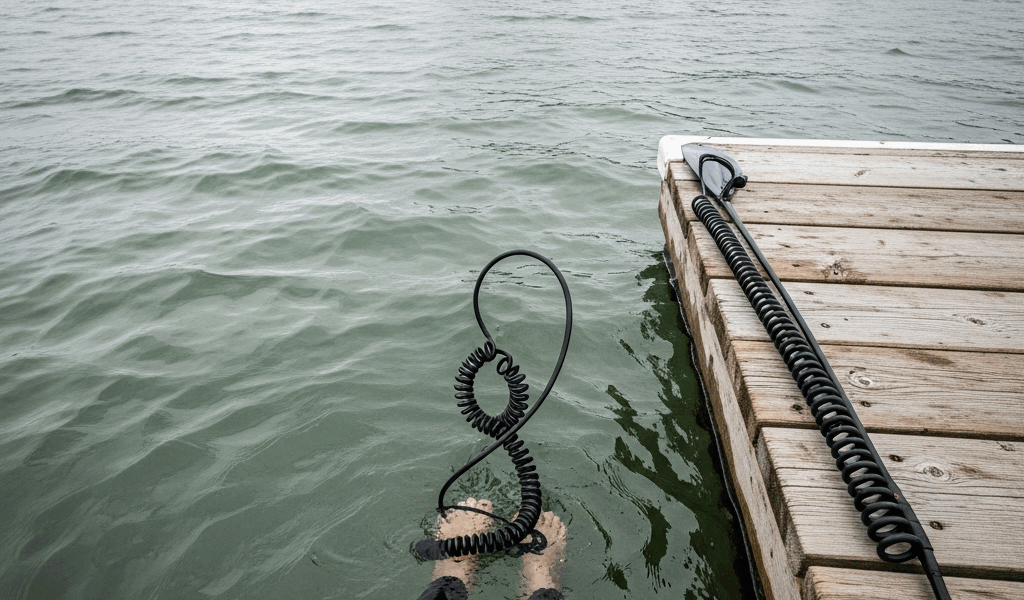
Why Your Leash Keeps Tangling in the First Place
SUP leash tangling has gotten complicated with all the conflicting advice flying around. But honestly? The actual problem is simpler than most people think. As someone who spent two embarrassing summers wrestling with a coiled mess around my ankles in Lake Union, I learned everything there is to know about why leashes tangle — and how to stop it. Today, I will share it all with you.
There are exactly two culprits. Once you figure out which one applies to you, the fix takes maybe ten minutes.
First possibility: wrong leash type for your conditions. Coiled leashes and straight leashes do fundamentally different things. A coiled leash is designed to hover near your board on flat, still water — it floats close to the deck, stays out of your way during calm-water touring or SUP yoga. Fine. Great, even. But the second you hit chop, current, or boat wake, that coil unravels and wraps itself around your legs like it has a personal grudge. Elliott Bay doesn’t care about your coiled leash. Neither does even moderate wind-driven texture on Lake Union on a Tuesday afternoon.
Second possibility: wrong attachment point. Ankle to board sounds like standard advice. It is standard advice. It’s also the tangle trap nobody warns you about. Your ankle is low, it moves constantly, and a leash hooked there has maximum opportunity to wrap — especially if you’re falling or paddling in anything other than glass-flat conditions.
Probably should have opened with this section, honestly. Most people assume their leash is defective or that they’re just bad at paddleboarding. Neither is true. They’re using equipment designed for one situation in a completely different one. That’s not operator error. That’s a mismatch.
Coiled vs. Straight Leash — Which One You Actually Need
But what is a coiled leash, really? In essence, it’s a retractable-style tether with spring memory built into the cord. But it’s much more than that — it’s also a liability the moment conditions stop being perfect.
Coiled leashes have their place. Lake Union on a windless Wednesday morning? Coiled leash is fine. The Sea-Doo traffic and afternoon current on that same lake three hours later? Now it’s a problem. These leashes are excellent for flatwater touring and SUP yoga. Anywhere calm and predictable. That’s the ceiling.
Straight leashes are built for movement. Surfers figured this out decades ago. So did anyone paddling open ocean, river mouths, or coastal water with tidal push. A straight leash has no memory. It just floats behind or beside you — staying mostly clear even when you’re falling and scrambling back up repeatedly. That’s what makes the straight leash endearing to us Pacific Northwest paddlers, where conditions shift fast and flat water is never guaranteed for long.
So, without further ado, let’s dive into the actual recommendation. If you’re exclusively paddling Union, Green Lake, or similar protected flatwater, a coiled leash is acceptable. If you’re touching Puget Sound, Elliott Bay, any river mouth, or paddling during afternoon wind windows — go straight. Cost difference is negligible. Most quality straight leashes run $28 to $45. A decent coiled alternative is $20 to $40. The cheap coiled leash bundled with a beginner board is usually the culprit — those budget coils have memory issues and weak swivel hardware that fails fast.
Most people don’t realize they have a choice. They buy a first board with a bundled leash and assume that’s it. It’s not. Spend ten minutes on REI’s site or walk the paddlesports aisle. Straight leashes are thicker, non-coiled, and labeled plainly. Coiled leashes are visibly coiled even sitting relaxed on a shelf. You’ll see the difference immediately.
Where You’re Attaching It Matters More Than You Think
Ankle attachment is conventional wisdom. It’s also the single biggest cause of tangling outside of perfectly flat water.
Your ankle sits at the end of a moving leg. When you fall — and you will — your leg swings hard. The leash swings with it. If that leash is long and coiled, it wraps. If conditions are rough and you’re trying to stabilize mid-fall, your legs go in multiple directions at once. Tangling becomes nearly inevitable. I’m apparently someone with unusually active falling technique, and calf attachment works for me while ankle attachment never did.
Don’t make my mistake. Move the attachment point 8 to 12 inches higher — from ankle to calf. Your calf moves less violently during a fall. The leash stays higher. Tangle risk drops dramatically. Most quality leashes come with interchangeable ankle and calf straps already included. You might already own the solution sitting in your gear bag right now.
Your board matters here too. Check the leash plugs on your tail. Many boards have two or three attachment points — and if you’re using a rear plug positioned for surf-style use, you might be on the wrong anchor entirely for SUP. Some boards have a dedicated plug positioned higher toward the center. If your board has options, test the higher one before spending money on a new leash.
Step-by-Step Fix for a Leash That Keeps Tangling
- Identify your leash type. Look at your leash right now. Coiled or straight? If it’s coiled and you’re paddling anywhere with current, wind, or chop, that’s your problem. Order a straight leash — a standard 9-foot straight leash costs $30 to $50 at most retailers. You’ll notice the difference on your first paddle out.
- Check your attachment point. Move from ankle to calf. On most leashes, this is just a strap adjustment — no tools, no extra parts. If your leash doesn’t have a calf option at all, you’ve found problem number two. Some older or budget leashes only include ankle attachment. A new leash with adjustable straps runs $35 to $50. Still cheaper than a panicked water rescue situation in 50-degree water.
- Reset your coiled leash if you’re keeping it. If you’re committed to using a coiled leash in flat conditions, it might have memory kinks from storage. Stretch it fully and lay it straight in direct sun for about 30 minutes. A kinked or permanently twisted coil tangles far more easily. Some coils never fully relax — that’s your sign the leash is done and needs replacing.
- Measure your leash against your board. General rule: leash length should roughly match board length, or run slightly shorter. A 10-foot leash on an 11-foot board — fine. A 10-foot leash on an 8-foot board — asking for trouble. Check your board specs. Extra leash length means extra material creating extra tangle opportunity.
- Do a pre-launch check on land. Hold your board, strap in, and walk through a mock paddle. Swing your leg forward and back. Does the leash catch? Does it snag on the fins? If yes, adjust before you’re already floating. Five minutes of testing on shore saves 20 minutes of frustration once you’re on the water.
A Quick Safety Note for Cold Water Paddling
Pacific Northwest water temperature runs between 45 and 55 degrees for most of the year. A tangled leash after a fall isn’t just annoying out here — it’s a genuine hazard. Cold water makes rational problem-solving harder, fast. Frustrated by exactly this risk, manufacturers started producing leashes with quick-release wrist attachments and breakaway mechanisms several years ago. This new idea took off and eventually evolved into the safety standard serious paddlers know and rely on today.
While you won’t need a full whitewater safety kit for casual SUP, you will need a leash you can release quickly if something goes wrong. Practice undoing your ankle or calf strap on dry land — not once, but until it’s automatic. A leash that tangles and then prevents separation is a problem you absolutely do not want to discover in 48-degree water.




Stay in the loop
Get the latest seattle paddleboard updates delivered to your inbox.