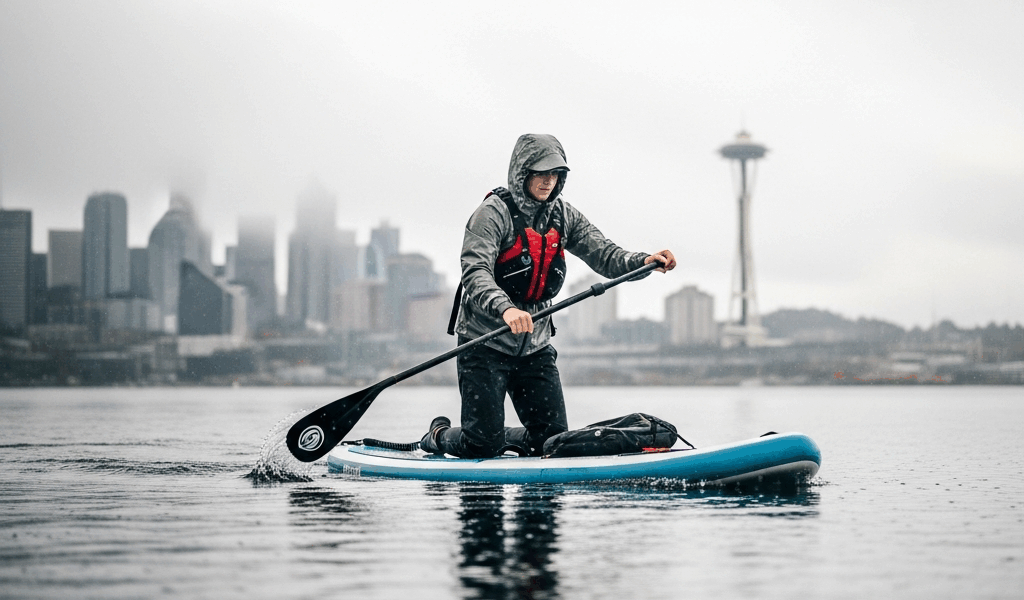
Paddleboarding in the Rain — What Seattle Paddlers Actually Do
This article includes affiliate links. We may earn a commission at no extra cost to you.
Rain vs. Lightning — The Only Distinction That Matters
Paddleboarding in Seattle has gotten complicated with all the conflicting advice flying around. But as someone who’s logged sessions on Lake Washington in every possible weather condition, I learned everything there is to know about the one rule that actually matters: rain is fine, lightning is not.
That’s genuinely the whole answer. If you moved here waiting for a sunny window to get on the water, you’re paddling maybe four times a year — spending the rest of your time staring out a coffee shop window at a perfectly rippled lake you’re not using.
Here’s the rule, and I’m not going to soften it: drizzle, overcast, steady rain, sideways mist — paddle. Lightning — do not paddle. That’s it. That’s the entire decision tree.
Western Washington doesn’t get a lot of lightning. Not zero, though — genuine summer thunderstorms push west from the Cascades, usually July through September. When that happens, you get off the water immediately and you don’t get back on until thirty minutes after the last strike. Not the last rumble. The last strike. I learned this the slow way by underestimating how fast a Cascade storm can move toward Lake Washington on a July afternoon. Got off the water when I probably should have gotten off twenty minutes earlier. Won’t do that again.
But here’s what doesn’t happen: the light Pacific Northwest drizzle that defines roughly 150 days of our year does not produce lightning. Overcast skies with steady rain coming off the Olympics? No lightning. Morning fog burning off slowly over Lake Union? No lightning. Check the forecast. If there’s no thunderstorm in it, you’re paddling.
The National Weather Service Seattle office posts forecast discussions that are genuinely useful — more detailed than most weather apps, honestly. Bookmark it. A standard rain forecast and a “chance of thunderstorms” forecast look very different when you read the actual text. Make that distinction and you’ve already made the only safety call that matters.
Where to Paddle in Seattle When It Is Raining
This is the section no brand blog based in San Diego can write for you. Spot selection in rain isn’t just about preference — it’s about wind exposure, fetch, and how fast conditions deteriorate when weather moves through.
Spots That Work Well in Rain
- Green Lake — This is my first call on a rainy day, full stop. Small freshwater lake, low fetch, almost entirely sheltered from meaningful wind, surrounded by trees that break whatever’s coming in from the north. The water stays relatively calm even when it’s raining hard. The loop is 2.8 miles if you hug the shore. On overcast weekdays, you’ll sometimes have the south end nearly to yourself — which feels absurd given how crowded it gets in July.
- Lake Union — South End Near the Docks — The south end near the Center for Wooden Boats gives you protected water, with the Capitol Hill and South Lake Union buildings blocking a lot of the north-south wind corridor. The houseboats along the east side create a natural buffer. Busy with maritime traffic, so stay aware — but the water itself behaves well in rain.
- Matthews Beach on Lake Washington — Tucked into the northeast corner of the city’s Lake Washington shoreline, Matthews Beach faces southwest, which means a south or southwest wind pushes into it. Worth checking before you go. But in typical northwest flow conditions, the point to the north provides decent protection and the water stays manageable. Good launch point for exploring the quieter northern reaches of the lake.
Spots to Skip When It’s Actually Raining
- Open Puget Sound — Puget Sound in real rain with any wind is a different environment entirely. Short, steep chop, ferry traffic, cold water. Not the day.
- Alki Beach — Alki is exposed to the south and southwest. Any real weather coming up from that direction turns that stretch into a washing machine. Skip it.
- Anything exposed to south wind on Lake Washington — The lake is long and oriented roughly north-south. South wind has 20+ miles of fetch to build on. The south end of the lake in a south wind is a bad day on a paddleboard — apparently a lesson several people relearn every season.
What to Wear — Rain Plus Cold Water Is a Different Problem
Probably should have opened with this section, honestly. It’s where most people get it wrong. Rain by itself changes what’s comfortable. Rain combined with 52°F water — which is roughly what Lake Washington and Lake Union run November through May — changes what’s safe.
Those are two different conversations.
For rain alone on a 60-degree day with warmer water: a splash top or cag over a synthetic base layer handles the wetness. Something like the Palm Surge Cagoule or the NRS Endurance Splash Jacket runs $80–$140 and keeps rain off your core. Underneath, a midweight merino or polyester base layer that doesn’t hold water when wet. Cotton is its own problem — leave it at home regardless of season.
For rain on cold water — and Lake Washington in March absolutely qualifies — you’re dressing for immersion, not for the drizzle on your shoulders. That means a wetsuit under your waterproof outer layer. A 3/2mm full suit handles water in the low 50s for the duration of a typical fall-and-self-rescue sequence. The rain layer goes over it. Neoprene gloves — the NRS Maverick Mitts are a Seattle-shelf staple — keep your hands functional when the water is genuinely cold.
Don’t make my mistake. For years I dressed for air temperature and ignored water temperature entirely. You don’t fall in when it’s convenient. If the water is 50°F and you go in without a wetsuit, you have minutes — not the leisurely swim back to your board you’re imagining.
Board Handling in Rain — What Changes
A few things shift when everything is wet. Worth knowing before you’re on the water figuring them out in real time.
- Traction pad grip — Quality EVA traction pads don’t get dramatically worse when wet, but entry-level boards sometimes have thin pads that lose grip fast. If yours feels slippery, bare feet often grip better than water-saturated sandals. Know before you launch.
- Paddle grip — Wet hands on a smooth shaft is a real thing. Some people use neoprene paddle gloves. Others wrap their top hand position with Yakgrips or similar tape. I’ve used both — thin neoprene gloves in cold rain handle the temperature and the grip issue together, which makes them the better call.
- Visibility — Rain drops visibility for other people trying to see you. Wear something bright. A $12 hi-vis vest over your paddling layer works fine. Don’t be the gray-and-black paddler in gray-and-black rain on gray water.
- Your phone — It needs to be in a waterproof case, not a water-resistant case — there’s a difference. The Lifeproof FRĒ or a simple dry bag works. A wet phone isn’t a minor inconvenience. It’s your navigation, your emergency contact, and your weather check, all gone at once.
Is It Worth It?
Yes. Genuinely, completely yes. And not in a “embrace the misery, build character” way — in a “this is actually beautiful” way that I don’t think gets said enough.
But what is paddling in the rain, really? In essence, it’s the same sport. But it’s much more than that. Glassy water in steady rain has a quality that flat-calm sunny water simply doesn’t. The surface texture from raindrops, the low light, the way sound carries differently when the air is wet — it’s a different experience, not a worse one. Green Lake on a gray Tuesday morning with light rain coming down is one of my favorite places to be in this city. The joggers are still out but the crowds are gone. The far shore disappears into the mist. You can hear the rain hitting the water around you. That’s what makes Seattle paddling endearing to us locals — the gray days are part of the deal, not the obstacle.
Morning mist on Lake Union — the kind that sits low over the houseboats and makes the Aurora Bridge look like it’s floating — is a Seattle signature. You earn that view by being on the water before the sun burns it off, which means being on the water when it’s still cool and often still overcast. That’s not a consolation prize for bad weather. That’s the actual thing.
Frustrated by years of watching perfectly good paddle days evaporate because I waited for blue sky, I started tracking my sessions on a little notebook I kept in my dry bag — nothing fancy, just date, location, conditions, time on water. Turns out my best two-hour windows on Lake Washington were overwhelmingly overcast days with light rain. Fewer boats. Calmer water. No glare. The math works out.
Get a wetsuit. Get a splash top. Pick a protected spot. Check for lightning and only for lightning. Then go paddle.

Stay in the loop
Get the latest seattle paddleboard updates delivered to your inbox.