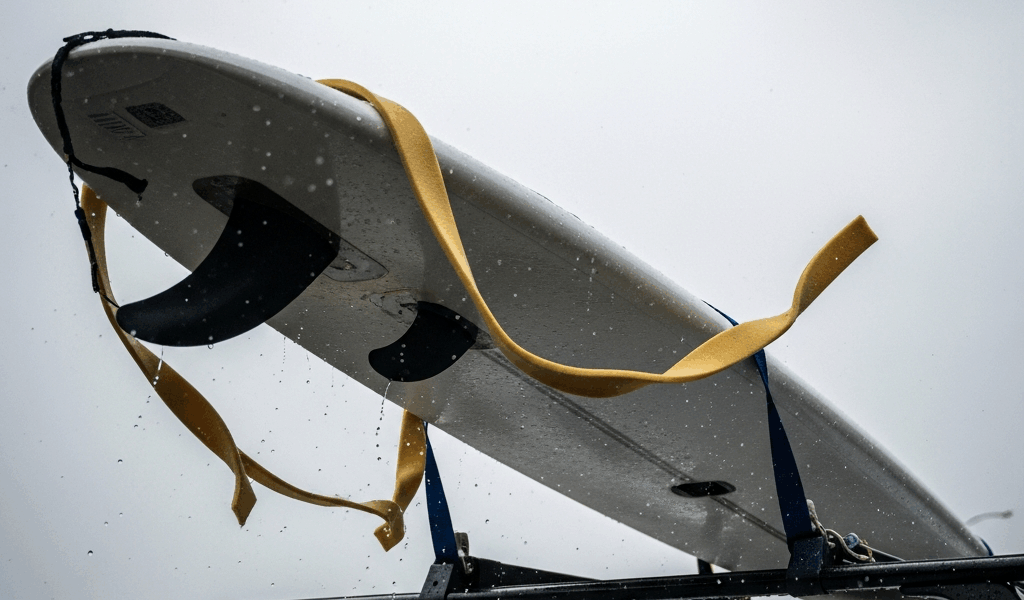
Why Your Board Won’t Stay Put on the Rack
Roof rack transport has gotten complicated with all the conflicting advice flying around. As someone who nearly lost a $1,200 hardboard off a Honda Civic on I-5 during a rainstorm at 60 mph, I learned everything there is to know about keeping a paddleboard secured to a roof rack. Today, I will share it all with you.
Here’s the short version: your board is moving because your straps are loose, your bow and stern lines don’t exist, or your mounting system has quietly given up on you. Pick one. Probably all three.
Foam blocks compress. That’s just what they do — especially after a summer of UV exposure and repeated weight cycles. Once they go shiny and flat, your board sits lower than it should and rocks side-to-side every time you change lanes. Wet boards are slippery boards. Water sits between the hull and your padding like a lubricant, and in Seattle, boards are always wet. J-cradles and saddle racks behave differently depending on board width and rocker profile too. Inflatable SUPs shift more than hardboards — they’re lighter, less rigid, and wind gusts can actually lift them off the rack at highway speeds.
What feels rock-solid in a parking lot gets genuinely scary at 65 mph. Highway speeds amplify everything.
Fix 1 — Check Your Strap Direction and Buckle Position
Most people cinch their straps down and call it done. That’s the mistake. Don’t make my mistake.
Your cam buckle or ratchet strap needs to run perpendicular to the board’s length — meaning straight across the top from one side of the rack bar to the other. The buckle itself should sit against the rack frame, not pressed into the board surface. When a buckle contacts the board directly, it creates a pivot point. Wind and vibration at highway speed work that buckle like a lever, gradually backing the strap off until you’re running on friction and optimism.
Cam buckles are better for paddleboards than ratchet straps, honestly. Ratchet straps have teeth that can slip under load — especially on wet surfaces. Cam buckles use friction. They don’t loosen unless you manually unwind them. I switched to Rhino Rack Cam-Buckle straps ($28 for a pair) after that first close call on I-5. Zero slippage since. I’m apparently a cam buckle person now and that brand works for me while ratchet straps never did.
Here’s a simple test: tighten the strap to snug, not crushed. One finger should slide underneath. If your finger won’t fit, you’re overtightening — which stretches the webbing and causes creep over long drives. If two fingers slide in easily, it’s too loose. One finger. That’s the rule.
Run the strap straight across. No diagonal angles — diagonal straps create torque and actually encourage the board to rotate.
Fix 2 — Add Bow and Stern Tie-Down Lines
Strapped at the rack alone is not enough at freeway speeds. I cannot overstate this.
Horizontal roof straps handle vertical lift and side-to-side shifting. What they do not handle is forward and backward sliding. On I-5 and the 520 bridge — where gusts routinely hit 30 mph or more — your board needs diagonal lines running from the nose and tail down to your vehicle’s frame.
Use marine-grade rope or nylon webbing, 5/16 inch or wider. Front of the board down to your front tow hook. Tail of the board back to your rear tow hook. Roughly 45-degree angles — not vertical, not horizontal. Tension them until they have slight resistance when you tug by hand. They’re not meant to carry load. They’re trip wires that catch the board before it travels anywhere.
Tired of fumbling with knots? Ratchet straps work fine for bow and stern lines too. Attach them using loop handles or D-rings rated for your board material — fiberglass hardboards can handle basically anything, but inflatables need soft attachment points. I’ve been running Yakima Gatekeeper straps ($35) through three Pacific Northwest winters and they haven’t complained once.
This single addition has stopped more boards from sliding than anything else on this list. Most people skip it. That’s what makes bow and stern lines so endearing to those of us who’ve had a close call — they’re boring, cheap, and they just work. So, without further ado — add them.
Fix 3 — Use Non-Slip Padding or Upgrade Your Mounts
Probably should have opened with this section, honestly.
Your foam blocks are failing. Accept it. Foam softens, compresses, and loses grip — the top surface goes shiny within two or three years if you’re racking your board weekly in wet weather. Shiny foam is slippery foam. Fresh blocks cost $20–$45 and grip wet boards immediately better than whatever worn-out pads you’re currently using.
But what is the better option? In essence, it’s moving to J-cradles or soft-top saddles. But it’s much more than that. Thule’s J-Cradles ($120–$160) hold the board vertically by the rails — grip becomes mechanical rather than friction-based, which means wet conditions stop mattering so much. They add a little wind resistance and they’re not the prettiest thing on your roof. They work anyway.
Inflatable SUPs need different treatment than hardboards. Lighter boards compress slightly under their own weight, which makes them settle deep into foam blocks — looks secure, but actually creates a rigid catch point that shifts dramatically when wind pressure changes direction. Space your mounting blocks wider than you think you need to. If your iSUP runs 32 inches wide, position blocks at the 20-inch and 60-inch marks rather than the 25-inch and 55-inch marks. The wider stance cuts rocking noticeably.
Yakima FatCat EVO saddle racks ($110–$150) work well for both board types — designed to cradle the board’s widest point while accommodating thickness variation. The padding is textured, not smooth. That detail matters more than people realize.
Quick Pre-Drive Checklist Before You Leave the Lot
- Board is centered on the rack — not pushed forward or back
- Horizontal straps are snug (one-finger rule) with buckles sitting on the frame, not the board
- Bow and stern lines are attached and tensioned to the front and rear tow hooks
- No webbing dangling or twisted where it can flap at speed
- Fins and rails are not being crushed by straps
Do a 30-second tug test before you leave. Push the board forward, backward, side-to-side, up. Parked. It should not shift more than half an inch in any direction. If it does, tighten something — you’ll know what.
Drive 10 minutes at normal speed, then pull over and recheck. Straps settle after initial loading. That’s normal. Check again after another 15 minutes on a long haul. One minute of re-tensioning saves you a ruined $800 board and a miserable afternoon on the shoulder of I-405.
Seattle weather and highway speeds are unforgiving. First, you should fix this right — at least if you want the board to arrive where you’re going.


Stay in the loop
Get the latest seattle paddleboard updates delivered to your inbox.