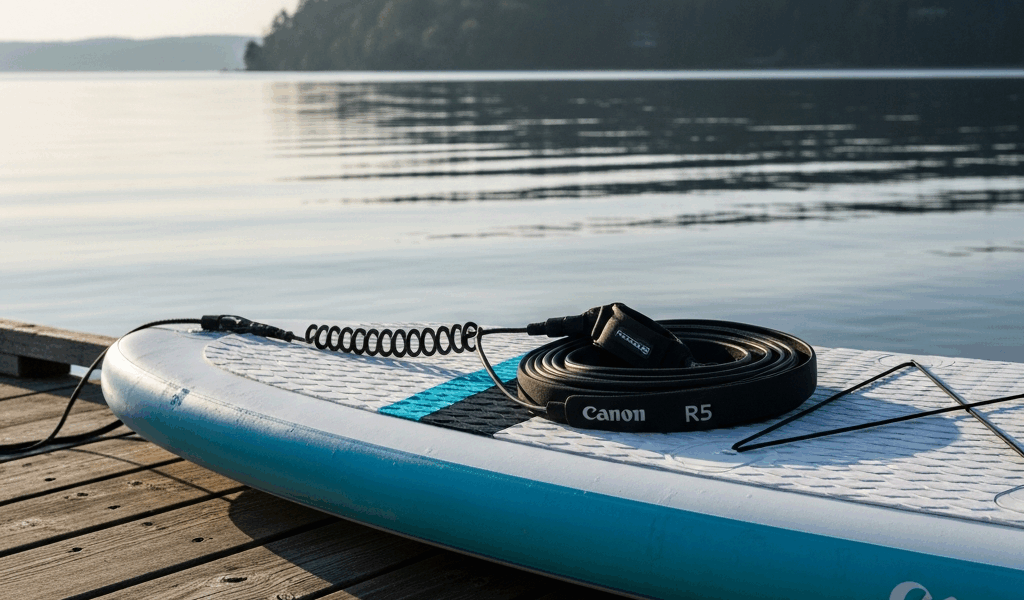
Why Your Paddleboard Leash Keeps Tangling — And Why It Matters
A paddleboard leash has gotten complicated with all the tangling flying around. I’ve been paddling at Green Lake for three years now, and I’ve watched the same mistake happen a hundred times. Someone wraps the leash around their ankle in a tight coil, pushes off from the dock, and within five minutes they’re standing on their board frantically picking at knots while their friends drift past them.
The frustration is real. But what actually matters here — tangles aren’t just annoying. They’re a safety problem, honestly. A tangled leash can restrict your movement when you need it most, especially during transitions between boards or in unexpected currents. I learned this the hard way when my own leash wrapped around my leg during a dismount at the Green Lake boat launch, and I nearly went in wrong.
Tangles happen because of how leashes naturally coil and how water moves around them. Your leash has memory. Every time you wrap it tightly, it wants to stay that way. Then friction from water, your body, and the board surface creates loops and kinks. During transitions — when you’re moving between boards or hopping off in shallow water — the leash gets yanked and pulled in directions it wasn’t designed for. That’s when loose coils turn into actual knots.
In crowded launch areas like Green Lake’s north shore parking lot, where boards are packed shoulder-to-shoulder, your leash tangles with other people’s gear too. Add wind, slight currents, or the simple fact that you’re new to the sport, and the leash becomes an hours-long source of frustration that eats into your actual paddling time.
The Right Way to Coil Your Leash Before Paddling
Coiling prevents tangles. Most people coil wrong, though.
Start with the ankle cuff in your hand. The cuff is that velcro-wrapped section that goes around your ankle — mine’s a bright orange Catch Surf model, about 4 inches of neoprene. Hold it loosely. Don’t grip it.
Now make loose loops with the leash. About the size of a dinner plate. One loop. Then another. And another. You’re aiming for maybe 5 to 7 loops depending on your leash length. Most paddleboards use 6-foot or 8-foot leashes, so you’ll have roughly 4 to 5 loops depending on thickness. Keep your hand relaxed while making them.
Here’s the critical part that most guides skip — don’t cinch them tight. You want the loops to sit loosely stacked, not compressed. Think of how you’d loosely bunch a rope, not how you’d coil a garden hose in preparation for storage. The difference is tension. Coiled tightly, the leash remembers that tension and wants to knot. Loose, it stays cooperative.
Position the coiled leash where it won’t tangle during paddling. I wrap it around the ankle cuff itself — just letting the loops sit near the velcro closure. Some paddlers prefer to hook it under a board handle or tie it loosely to their board’s leash attachment point. Either works. The goal is keeping it away from your actual ankle joint where movement creates friction.
Never, and I mean never, wrap the leash around your calf or thigh. I see people do this thinking it’s secure. It’s the opposite. Your leg moves constantly, and that movement creates shearing forces that pull loops into knots faster than anything else.
Best Practices to Stop Tangles During Water Time
Once you’re in the water, the real prevention work begins.
Keep your leash loose at the ankle. The ankle cuff should be snug enough that it won’t slide off, but not so tight that it restricts blood flow or movement. I can fit one finger between my ankle and the cuff — that’s the target. A tight cuff creates pressure points where the leash naturally kinks and loops.
When you’re sitting on your board paddling, let the leash hang freely in the water. Some paddlers are paranoid about this. Don’t be. The leash floats — most modern leashes use buoyant materials — and the water naturally keeps it from tangling around you. I’ve paddled Green Lake for hours with the leash just trailing. Zero tangles.
During transitions — the moment you’re getting off your board or switching from paddling position to standing position — this is where most tangles happen. Move deliberately. Don’t jerk the leash. When you’re about to dismount, take one second to check that the leash is on the side of your body opposite the direction you’re moving. If you’re stepping off the left side of the board, make sure the leash is on your right. This prevents it from getting caught under your body weight.
In currents or wind, the leash becomes unpredictable. At Green Lake, we don’t have serious currents, but the wind coming off the water can push your board and leash in different directions. When this happens, don’t fight it. Adjust your body position to match where the leash is naturally pointing. Let the leash lead instead of forcing your body into an awkward angle.
One habit that saves me constantly — I do a leash check every time I sit down after paddling. Takes three seconds. Run your hand down the leash, feel for kinks or knots, and manually straighten them before they tighten. Catch small tangles before they become big ones.
Quick Fixes When You’re Already Tangled
Sometimes prevention fails. You’re paddling, and suddenly the leash is wrapped around your leg. Here’s what actually works.
First — don’t panic. A tangled leash feels urgent, but it’s not. You have time. Stay on your board if possible. Most tangles can be solved without entering the water.
Use your paddle to help. Drop your paddle across the board in front of you — secure it so it doesn’t float away. I’ve lost one this way. Now use both hands to untangle. Work methodically from your ankle toward the loose end. Don’t yank. Each tug makes it worse. Gently pull loops free one at a time.
If the knot is genuinely tight, get off the board into shallow water and address it there. This is safer than contorting yourself on the board. Stand in water up to your waist, use both hands, and take your time. At Green Lake, there’s shallow water everywhere, so this is usually possible.
If you’re in deep water and the leash is genuinely stuck, the nuclear option is to unstrap from the ankle cuff entirely, untangle it in your hands, and reattach. This is rare, but it happens. The whole process takes maybe a minute. You’re still tethered to your board by the main leash attachment point, so safety isn’t compromised.
Leash Type Matters Too
Not all leashes tangle equally. Coiled leashes — the type that naturally want to stay in a loop — are more tangle-prone than straight leashes. But coiled leashes offer better water feel and less drag when paddling. It’s a trade-off.
Straight leashes eliminate most tangles because they don’t have that coiled memory. The downside is they drag more in the water and create slight resistance. I personally use a coiled leash because I prioritize how the paddle feels over absolute tangle prevention, but if you’re newer to paddling or paddling in choppy conditions, a straight leash might save you frustration.
Leash thickness matters. Thicker leashes (⅜ inch or more) are harder to knot but drag more. Thinner leashes (¼ inch) tangle more easily but feel lighter. My current leash is a standard ⅜-inch coil, and honestly, the prevention habits work so well that leash type feels secondary.
Use prevention habits first. The leash you already own will work fine.


Stay in the loop
Get the latest seattle paddleboard updates delivered to your inbox.