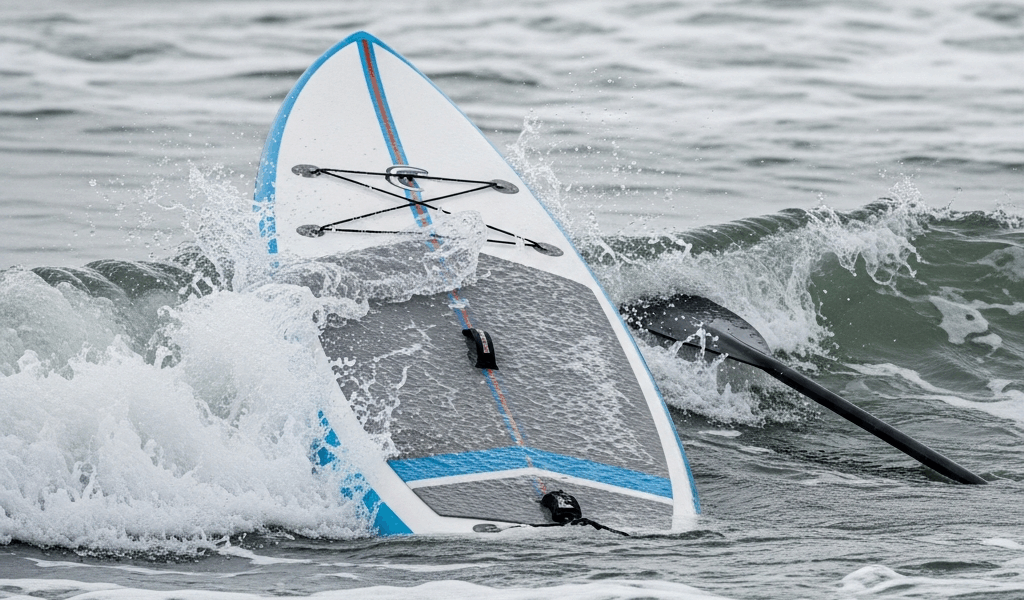
Why Choppy Water Is a Different Problem Entirely
Paddleboarding in rough conditions has gotten complicated with all the flat-water advice flying around. Most of it is genuinely useful — weight distribution, standing tall, core engagement. But none of it prepares you for what happens when a tour boat passes fifty yards away and the water turns into something alive beneath you.
As someone who capsized four times in a single July afternoon on Lake Union, I learned everything there is to know about the difference between flat-water balance and actual chop survival. Today, I will share it all with you.
Here’s what clicked for me eventually. Flat water asks one question: where is your weight relative to the board? Chop asks something harder — where is your weight relative to a board that’s moving in three dimensions simultaneously? Waves push the rails up and down. Wake rolls the nose sideways. Wind catches the tail. Your job stops being “stand still and centered” and becomes something closer to “stay centered while everything underneath you refuses to cooperate.”
Seattle makes this painfully obvious. Lake Washington gets brutal afternoon wind chop around 2 or 3 p.m. when the breeze comes through. Lake Union looks deceptively glassy until a Argosy tour boat passes and turns your session into a washing machine. That’s where most people discover their balance has a hard ceiling. The problem isn’t weakness or lack of coordination. The technique most people learn was simply never designed for moving water.
Fix Your Foot Position Before Anything Else
Probably should have opened with this section, honestly. Bad foot placement causes more tip-overs in chop than any other single factor — and it takes about thirty seconds to fix.
Feet centered over the carry handle. Hip-width apart. Toes pointing straight forward, not angled out, not staggered. Hip-width for most adults means roughly 8 to 10 inches between your heels. Toes forward means your weight distributes evenly across the balls of both feet without favoring either rail.
In flat water, being a few inches too far back just feels slightly awkward. In chop, it’s catastrophic. Feet too far aft pulls the tail down and lifts the nose. Now you’re riding a seesaw. Any wave that hits the nose while the tail is already heavy will flip you forward or cork you sideways as the nose digs and the tail rises to meet it.
Too far forward is arguably worse. The nose loads up. The tail becomes a pivot point. Any broadside wave uses that elevated tail as leverage and rolls you clean off — fast, with almost no warning.
Uneven foot placement is sneaky. One foot three inches ahead of the other creates rotational instability. The board corkscrews instead of rocking. I spent an entire session at Matthews Beach thinking my core was failing me. Filmed myself on my GoPro Hero 11, watched the footage, and immediately saw my right foot sitting nearly three inches behind my left. One adjustment. Everything changed. Don’t make my mistake.
Check position before leaving the beach. Stand on the board in calm water and feel for neutral — not tipping forward, not pulling back. That’s your baseline. From there, you can actually react to chop instead of fighting your own stance the whole time.
Lower Your Paddle Stroke and Widen Your Stance
Your paddle stroke is probably destabilizing you. That high, reaching stroke that looks clean on Instagram? It pulls you laterally off center with every single stroke. On flat water, you recover fast enough that it barely matters. In chop, that side-to-side movement stacks on top of the wave motion and shrinks your stability window fast.
Switch to shorter, more vertical strokes. Keep the paddle close to the rail — maybe 4 to 6 inches out. Straight down and back, not arcing outward. This keeps your torso stacked over your feet rather than reaching across the board and dragging your center of gravity sideways on every pull.
Widen your stance too. Move from hip-width to shoulder-width — roughly 14 to 16 inches between your heels. That’s it. That’s the whole adjustment. A wider base drops your center of gravity meaningfully without requiring any real skill. You lose a little efficiency. You gain stability. In chop, that trade is worth it every single time.
I’m apparently an inflatable person and my iRocker Cruiser 10’6″ works for me while hard boards never quite clicked. Inflatables flex and absorb chop more gently, but they also move beneath you more noticeably — the wider stance helps them disproportionately. Hard boards transmit wave energy more directly, stiffer underfoot, but a wider stance still improves your footprint distribution and keeps things manageable.
Combine vertical stroke with wider stance and the board stops feeling twitchy within a few hundred yards. It’s not subtle.
Read the Chop and Stop Fighting It
But what is good chop technique? In essence, it’s controlled absorption. But it’s much more than that.
Watch experienced paddlers in rough water. They look almost bored. Beginners look like they’re trying to hold a plank position while standing on a trampoline. The difference is that experienced paddlers stopped fighting the motion sometime around their second or third season and started moving with it instead.
Ankles flexed. Knees slightly bent — maybe 15 degrees, not a full squat. Think shock absorber, not statue. When a wave lifts one rail, let your ankle flex toward it. Let the knee follow slightly. Tensing up locks your body rigid and turns every wave into a full-torso event. Softening your joints lets the board move while your center of gravity floats relatively stable above it.
Angle into oncoming chop rather than taking it head-on or broadside. A 15-to-20-degree angle means each wave hits your rail obliquely instead of trying to lift the entire board straight up. The energy deflects outward. That’s what makes this approach endearing to us choppy-water paddlers — it works with physics instead of against it.
Know when to drop to your knees. This is not failure. This is tactics. Kneeling drops your center of gravity by 12 to 18 inches and gives you a contact platform with dramatically more surface area. In serious wake or sustained chop, getting on your knees is the smart move, full stop. You can still paddle efficiently. You’re in control. Your stability window essentially doubles.
Watch the water ahead — not your feet. Predict where the chop is moving. Shift weight fractionally before the wave arrives. After a few sessions, maybe four or five hours on genuinely rough water, this becomes automatic. It stops feeling like a skill and starts feeling like reading.
Board Width and Volume Could Be the Real Culprit
If you’ve addressed foot position, stroke technique, and stance width, and you’re still going over regularly, the board itself might be the problem. That’s worth taking seriously before spending another season fighting equipment.
A narrow board — anything under 30 inches wide — is genuinely difficult to stabilize in chop. Race boards run 26 to 28 inches wide because they prioritize glide and speed. In rough water, that width is a liability, not a feature. All-around boards typically land between 30 and 32 inches, which provides real stability without killing performance for recreational paddling.
Volume might be the best option to evaluate next, as choppy water requires genuine buoyancy. That is because a board sitting too low in the water has almost no margin for wave interference — every rail lift becomes exaggerated. If you’re over 200 pounds, you need 120 liters minimum. Pushing a marginally-sized board in flat water is manageable. In chop, that same marginal volume becomes exponentially harder to manage.
While you won’t need a brand new board immediately, you will need a handful of honest answers about your current equipment. Check the specs. If your board is under 30 inches wide or under 110 liters, and you’re tipping consistently after fixing everything else, that’s your answer. A wider board changes the entire experience — not gradually, but immediately.
So, without further ado, go check the carry handle placement on your board and move your feet. That one fix, right there, solves probably 40 percent of chop-related tip-overs before anything else needs addressing.

Stay in the loop
Get the latest seattle paddleboard updates delivered to your inbox.