Why Your Board Stalls Before Reaching Rated PSI
Inflatable paddleboard troubleshooting has gotten complicated with all the conflicting advice flying around. As someone who has dragged boards to cold beaches at 7am only to spend half the morning fighting a pump, I learned everything there is to know about this particular headache. Today, I will share it all with you.
So you’re stuck at 10 PSI. You’ve watched the YouTube video. You’ve double-checked the valve — or at least you think you have. The board still feels like a pool toy, soft at the edges, and you’re starting to wonder if you bought a lemon or if you’re somehow doing basic inflation wrong.
I’ve been there. Saturday morning, new Tobin board, 20 minutes of pumping, and an invisible wall at exactly 10 PSI. The water was right there. The board was right there. And I was standing on a beach getting progressively angrier at a piece of vinyl.
This article includes affiliate links. We may earn a commission at no extra cost to you.
Here’s what nobody tells you clearly: there are three completely separate problems that produce this exact symptom, and most articles treat them like variations of the same thing. They’re not. A stuck valve, a degraded pump, and a slow leak all look identical from the outside — board won’t firm up, pressure plateaus, arms are exhausted. But the fix for each one is totally different. Knowing which problem you actually have cuts troubleshooting from a two-hour ordeal down to maybe ten minutes.
The three culprits: A valve pin that’s stuck in open position and bleeding air as fast as you pump it in. A pump that’s either in the wrong mode or has a gauge so inaccurate it’s lying to you about your actual PSI. Or a slow leak — usually hiding at a seam, the valve stem base, or inside a fin box — that’s venting air faster than you can replace it.
So, without further ado, let’s dive in. Check each one in order. Skip nothing.
Check the Valve First — Most People Skip This
Probably should have opened with this section, honestly. The valve is the problem roughly 60% of the time, and it’s also the fastest fix by a wide margin.
But what is a Halkey-Roberts valve? In essence, it’s a two-position pin mechanism — one direction for inflation, one for deflation. But it’s much more than that. Inside the assembly sits a spring-loaded pin. Insert your pump head, and the pin compresses, opening an air channel into the board. Remove the pump, and the spring pushes the pin back up, sealing everything in. Clean, simple, effective — until it isn’t.
That pin gets sticky. Not fully jammed, just sluggish enough that air seeps back out while you’re pumping. You feel resistance building, hit 10 PSI, and then nothing. Your arms keep working. The gauge doesn’t move. That’s not a weak pump. That’s a pin that’s stuck slightly open and bleeding your pressure back out the moment each stroke ends.
How to check this: Pull the pump head off the valve completely. Look at the valve stem opening — there should be a small dimple in the center, the pin sitting flush and slightly recessed when it’s at rest. Grab your fingernail or the little plastic valve tool most pumps include (usually taped to the hose). Press the pin straight down and release it. You want to feel a crisp click and a definite spring-back.
Mushy? No click? That’s your problem. Flip the board valve-side down and pour a small amount of fresh water — a teaspoon, not a cup — directly around the pin. Work it up and down with your fingernail for about 30 seconds. The water frees up old dried lubricant that’s essentially gluing the pin in place. Dry everything thoroughly with a cloth before you try inflating again. Don’t make my mistake of skipping the drying step and then wondering why the valve feels weird.
That’s it. That simple process is the fix for the majority of boards reporting this exact symptom. If the pressure still plateaus at 10 PSI after the valve reset, move on.
Test Your Pump Before Blaming the Board
Hand pumps degrade. I’m apparently hard on equipment — I’ve destroyed two pumps in four years — and a seven-year-old bundled pump almost made me return a perfectly good board. The pump was the problem the whole time.
Two specific pump failures produce the stalling effect, and they’re easy to confuse with a board problem.
- You’re still in dual-action mode. Most halfway-decent pumps have a small lever or toggle near the pump head — sometimes it’s labeled, sometimes it’s just an unmarked switch. Dual-action moves air on both the push and pull stroke, which is great for getting from flat to roughly 8 PSI fast. Above that, single-action mode is what actually generates enough pressure per stroke to finish the job. I’m apparently the kind of person who reads manuals after something breaks rather than before, and this switch was news to me for longer than I’d like to admit. Check yours right now.
- Your gauge is lying. Cheap gauges — especially the ones bundled with entry-level boards — routinely misread by 2 to 3 PSI under high resistance. Your board might actually be sitting at 12 or 13 PSI while the gauge confidently displays 10.
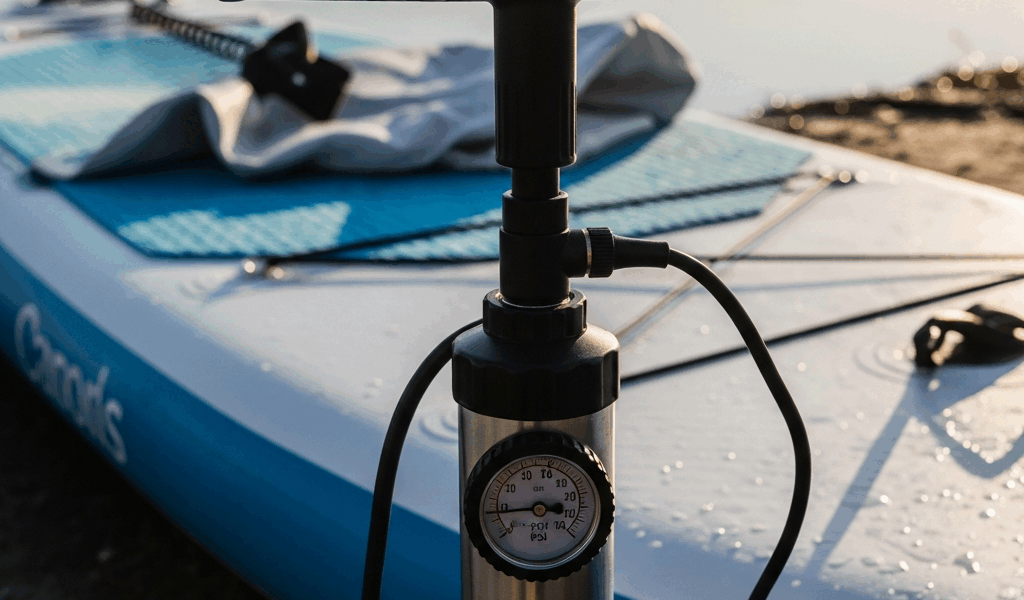
A basic digital PSI gauge might be the best option here, as diagnosing pump accuracy requires an independent reference. That is because your pump’s built-in gauge is the exact instrument under suspicion — you can’t verify a ruler by measuring it with itself. Digital gauges run $12 to $18 at any hardware store, sometimes less at Amazon. Attach it to your pump’s secondary output port or buy a small inline gauge that fits between the hose and valve. Inflate to what your pump claims is 10 PSI, then read the secondary gauge. If it shows 12 or 13, your pump was the culprit all along.
A quality hand pump runs $35 to $60 and will last years of regular use. An electric pump — the Seamax SUP20 runs around $89, the OutdoorMaster Shark 20 PSI electric pump is another popular choice — eliminates the whole conversation and inflates a standard board in under three minutes. Worth it if you paddle more than a few times a season.
If the secondary gauge confirms you are genuinely stuck at 10 PSI, you have a leak somewhere on the board.
How to Find and Fix a Slow Air Leak
Slow leaks are invisible until you know the exact spots to check. A board that drops more than 1 to 2 PSI over a full day on the water has a leak. A board that holds pressure overnight but goes noticeably soft after 30 minutes of paddling — same story.
The soapy water method is what actually works here. Mix dish soap and water in a spray bottle, roughly 1 part soap to 3 parts water. Inflate your board to whatever PSI it actually reaches, then spray every potential failure point systematically:
- Both sides of every seam — pay extra attention to the rails and the bottom spine seam.
- The valve stem base where the assembly meets the board material.
- Every fin box opening or external patch.
- D-ring attachment points, especially older or heavily used ones.
- The valve cap itself — sometimes it’s just not seated flush.
Bubbles mean air is escaping there. Even tiny, slow-forming bubbles count. Mark each spot immediately with a permanent marker so you don’t lose it when you flip the board over.
One thing worth mentioning — temperature affects your gauge reading more than most people realize. A board inflated to 12 PSI on a 65-degree morning can read 9 or 10 PSI by midday if the air temperature drops to around 50 degrees. That’s thermal pressure drop. Physics, not a defect. The board actually is softer because it is, technically — warm it back up, the pressure returns. That’s what makes physics endearing to us paddlers who just want a straight answer.
For actual leaks: small seam cracks seal up cleanly with a vinyl repair patch kit, which runs $8 to $12 at most outdoor retailers. Valve stem leaks need a full valve assembly replacement — it’s a 30-minute job if you have the right wrench, and replacement valves are usually under $10. Delaminating seams or visible structural cracking? That’s a different category entirely.
When to Return It Instead of Fixing It
Some things aren’t worth patching. Return the board if the valve housing is visibly cracked, if a seam is peeling apart where you can see daylight through it, or if the board drops more than 2 PSI overnight after a full proper inflation with no temperature change involved.
Frustrated by vague return policies, most Costco shoppers don’t realize the return window there is genuinely generous — usually 90 days, often longer for larger purchases, and they’ll take back used merchandise if there’s a manufacturing defect. Tobin and Body Glove boards show up at Costco constantly. Bring the board, bring the receipt, and be direct. Don’t overthink the conversation.
For other retailers, pull up the warranty documentation before you call. Most consumer-grade inflatable boards carry a one-year manufacturer’s defect warranty. A slow leak that started before you ever paddled the thing is a manufacturing defect. Frame it that way: “Board won’t reach rated PSI despite correct pump operation and no user damage.” That’s the language warranty departments respond to.
Start with the valve. Check the pump. Find the leak. Know when to stop troubleshooting and just return it. Your board will be firm and ready in under an hour — probably less if the valve was the issue all along.




Stay in the loop
Get the latest seattle paddleboard updates delivered to your inbox.