Why Paddleboards Absorb Water So Easily
I’ve been paddleboarding on Puget Sound for six years, and my first major panic came when I noticed my board feeling soft in the middle after a particularly wet autumn day. That’s when I learned the hard way why paddleboards absorb water so easily—and honestly, the Pacific Northwest is basically a master class in board degradation.
Inflatable paddleboards have this multi-layer construction with an air-tight PVC outer shell. Sounds waterproof, right? Except small punctures, valve leaks, and seam separations create entry points for water into the foam core. Once water enters that core material, saturation happens fast. The foam drinks it up like a sponge. Hard boards face different problems entirely—they delaminate. The outer fiberglass layers separate from the foam or wood core when water penetrates a crack or ding. Both scenarios spell trouble.
In wet climates like Seattle, moisture doesn’t just dry—it lingers. I’ve seen boards stored in garages for three weeks still weeping water from their cores. The difference between a quick-drying situation and chronic waterlogging often comes down to immediate action and smart long-term storage.
Quick Drying Method After Every Use
Probably should have opened with this section, honestly. Most waterlogging problems start because people skip the post-paddle routine.
Here’s what I do every single time I come off the water, and it takes maybe 10 minutes total:
- Rinse immediately with fresh water. Salt and freshwater both corrode valve seals and weaken PVC. I use a garden hose or tap water at the dock—3 minutes, tops. Don’t skip this.
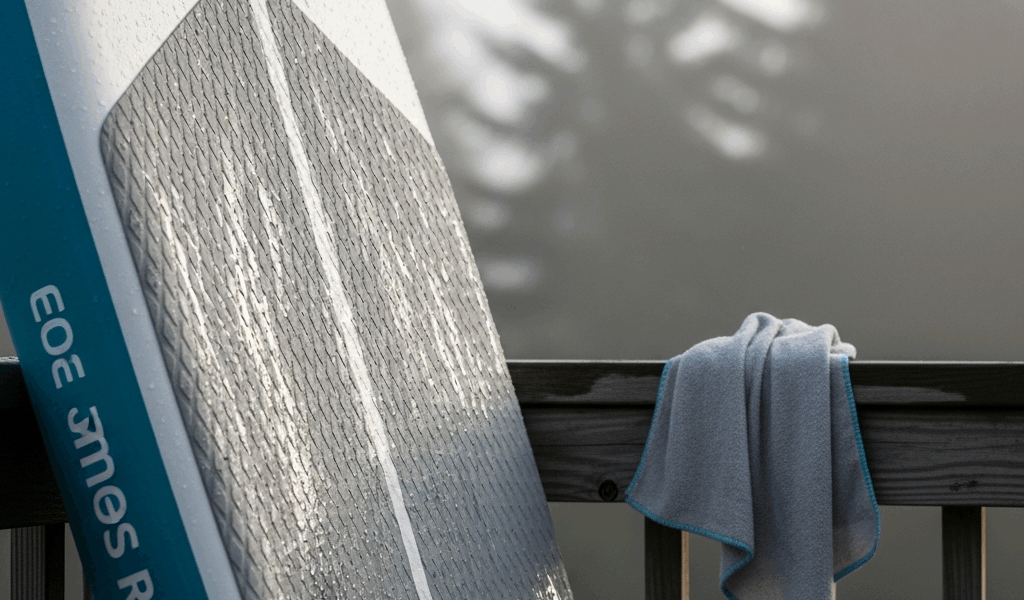
- Wipe the entire board dry. Microfiber cloth works best, though I use an old towel and hit every surface—top, bottom, sides. Water trapped in crevices around handles and valve areas is where mold starts. Takes about 4 minutes.
- Open all valve caps. Leave them open during this phase. Trapped moisture inside the board will condense, and open vents let air circulate properly. I’ve learned this the hard way after finding murky water pooling in my 2022 Aqua Marina Vapor board.
- Stand the board upright against a wall. Leaning it flat traps moisture underneath—never ideal. Vertical orientation lets gravity drain any water that’s made it inside. Position the main valve at the bottom so water can escape if it’s in there. Leave it standing this way for at least two hours, ideally overnight.
- Position it in airflow. A fan pointed at the board speeds everything up significantly. I have a simple box fan on my garage floor that cuts drying time from overnight to 4–6 hours. Not essential, but worth having if you paddle frequently.
- Check the weight. A dry board feels noticeably lighter. If it still feels heavy after a full night standing upright, water got inside. This is your signal to move to deep drying mode.
- Store with the main valve open. Once it’s actually dry, I leave the valve cap off during storage. This prevents pressure buildup and allows any ambient moisture to escape rather than condense inside.
The key: this routine prevents 90% of waterlogging problems. I’m serious. The boards that end up chronically wet are the ones people just leave in garages after paddling without thinking about it.
Deep Drying for Waterlogged Inflatables
Frustrated by a really frustrating experience with my wife’s Hala Gear board last February, I developed a system for boards that clearly have water inside.
First, identify the problem. Pick up the board. Does it feel heavier than normal? Can you hear water sloshing around inside? Does the core feel mushy or soft in certain spots? If you’re answering yes to any of these, water is trapped inside.
The partial deflation technique works. Deflate the board to about 60% of full pressure. This creates space inside the air chamber for water to pool rather than staying distributed throughout the foam. I use my manual pump (Bravo 3-in-1, about $35) set to deflate mode. Takes 10 minutes.
Now position the board strategically. Lay it flat with the main valve at the lowest point of your floor—literally tilted if possible. Let gravity pull water toward that valve. Every 4–6 hours, rotate the board 180 degrees so the opposite end becomes the low point. This helps water migrate toward the valve over time.
Vents matter here. Leave both the main valve and any secondary vents completely open. Don’t cap them. I learned this when I tried closing a vent too early in winter and trapped moisture inside for two weeks straight.
Sunlight is your friend, but Seattle rain is not. On rare sunny days here in the Pacific Northwest, I move the board outside for 6–8 hours. Direct UV actually accelerates moisture evaporation from the foam. When it rains—which, let’s be honest, is most of the time—keep it under a carport or garage overhang. Covered but with airflow.
Timeline: a waterlogged inflatable typically takes 3–7 days to dry completely with this method, depending on how much water got inside and whether you have sunny weather. Winter in Seattle? Plan on 10–14 days minimum.
The humidity factor is real here. Puget Sound region garages stay around 60–70% relative humidity year-round. Even fully dry boards can reabsorb moisture if stored in sealed spaces. I’m apparently obsessive about keeping my garage door cracked during the day for ventilation.
Preventing Mold in Stored Wet Boards
Mold isn’t just a cosmetic problem—it eats PVC and foam. I found black spots inside my first waterlogged board after leaving it sealed in a garage for three weeks in November. Shipping the board back to the manufacturer for inspection cost $200.
Prevention starts with storage setup. Here’s my current system:
- Vertical storage with space between boards. I mounted two PVC pipe racks in my garage (cost about $60 in materials). Boards stand upright with valves open and at least 3 inches between each one. Air circulates completely around them.
- Garage vs. shed consideration. Sheds without insulation get way too damp in winter. My unheated detached garage actually stays drier because it’s connected to the house and gets minimal temperature swing. Storing in a shed? You need active moisture control.
- Moisture absorbers are essential. I use DampRid hanging containers (about $5 each, available at Home Depot) throughout my storage area. One 32-ounce container per 300 cubic feet. Replace them monthly during rainy season—October through April here. Cost: $30 per season. Non-negotiable if you’ve had mold problems.
- Dehumidifier during wet months. I run a small 50-pint dehumidifier (Frigidaire model, $200 one-time cost) in my garage November through March. It keeps humidity below 55%, which stops mold dead. Pays for itself after one prevented board replacement.
- Inspection intervals. I check stored boards every two weeks during wet season. Look inside valve openings with a flashlight. Any visible mold or smell means immediate action needed. Early detection saves boards.
The Seattle reality: garages get damp. It’s not a failure if you find moisture—it’s expected. The system is designed to prevent that moisture from becoming mold.
When to Replace vs. Restore a Waterlogged Board
Sometimes you can’t save it. I learned this the hard way.
Warning signs that a board is beyond basic drying:
- Soft spots that don’t firm up after 10 days of deep drying
- Visible black or green mold inside the board (visible through vents or after opening a seam)
- The smell of rot or mildew that doesn’t improve
- Hard boards with visible separation between layers (delamination)
- Valve damage that won’t seal (new valves cost $50–$150 to install)
Cost-benefit math is straightforward: professional board repair (seam sealing, core replacement) typically costs $300–$800. A replacement entry-level board costs $400–$600 new, or $200–$400 used. If your board is already 5+ years old, replacement often makes more sense than restoration. If it’s new, repair is worth attempting.
My wife’s Hala board that got waterlogged? We eventually replaced it with a used Zray board off Craigslist for $350 after the repair quote came back at $600. The original board had already survived three seasons of hard use anyway.
The honest answer: aggressive drying within the first 24–48 hours prevents needing this decision at all. The boards that end up trashed are the ones people procrastinate on. Water damage gets exponentially worse every week you delay.

Stay in the loop
Get the latest seattle paddleboard updates delivered to your inbox.