Your fin worked fine at launch. Twenty minutes out, the board started pulling sideways — and when you actually checked, it was hanging at an angle or gone entirely. This is more common than it should be, and the fix is almost always something you can sort out at home before your next paddle.
The catch: there are three completely different fin systems used on inflatable paddle boards, and the fix depends entirely on which one you have. Costco board owners (Tobin Sports Endeavor Elite, Body Glove Performer) are in a different situation than someone with an iRocker or Gili. Here’s how to work through each one.
First — Identify Your Fin Box Type
Nothing else here is useful until you know what system you’re dealing with. Three types:
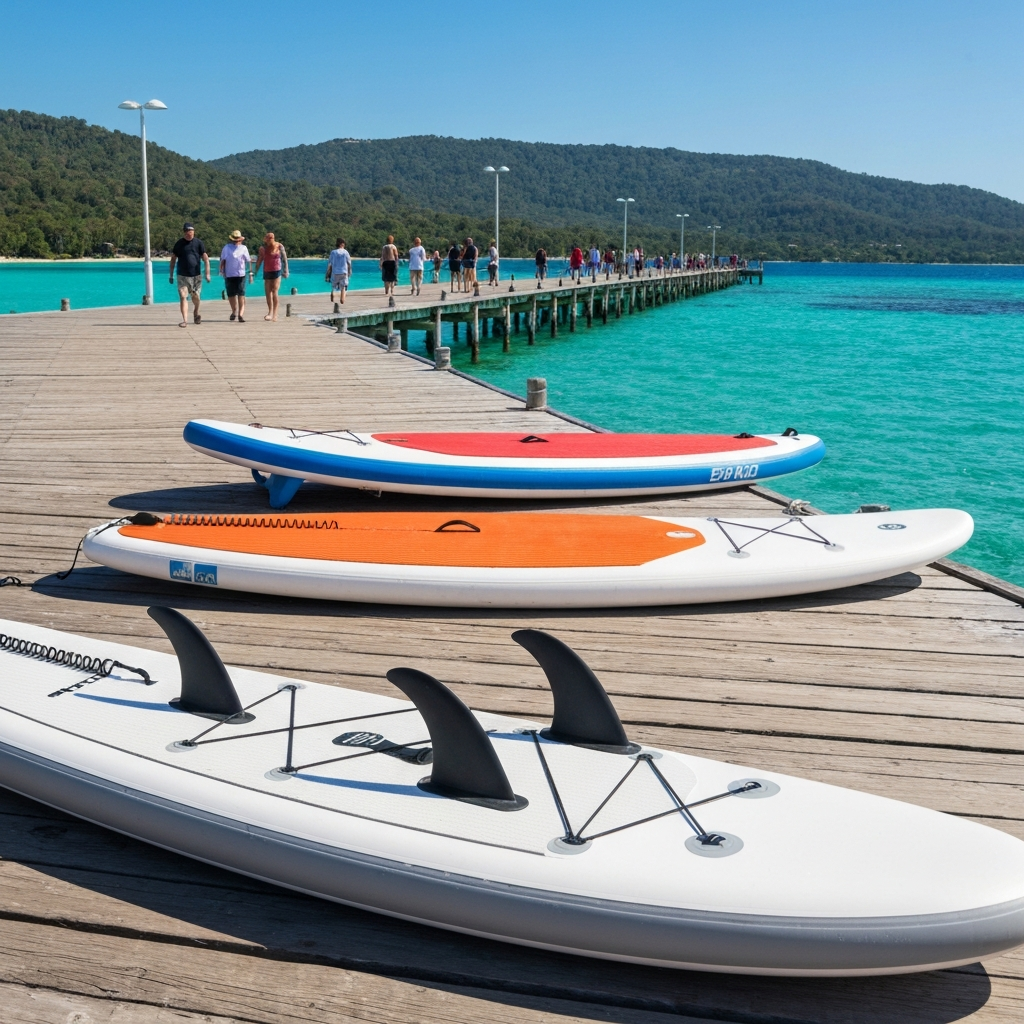
- US box — A long plastic channel, slightly wider at the base, running front-to-back on the underside of the board. Fin slides in from the front, secured by a bolt and plate. Needs a fin key or flathead to tighten. The most common system on non-branded and mid-range boards.
- Snap-lock / lever-lock — Compact box with a plastic lever or cam on the side. Fin clicks in with no tools. What iRocker, Gili, and Aqua Marina use. You’ll see the lever right on the box body.
- Screw-tab — Fin held by one or two screws threading up from the underside of the board into the fin base. No channel at all. This is what most Costco boards use — Tobin Sports Endeavor Elite, Body Glove Performer, basically any retail/big-box brand.
Flip your board over and look. Once you’ve identified yours, skip directly to that section.
Fix for US Box Fins
Two reasons a US box fin falls out: the bolt isn’t actually tight, or the fin is loose in the channel even when the bolt is snug. Both are fixable, and you should check the bolt first.
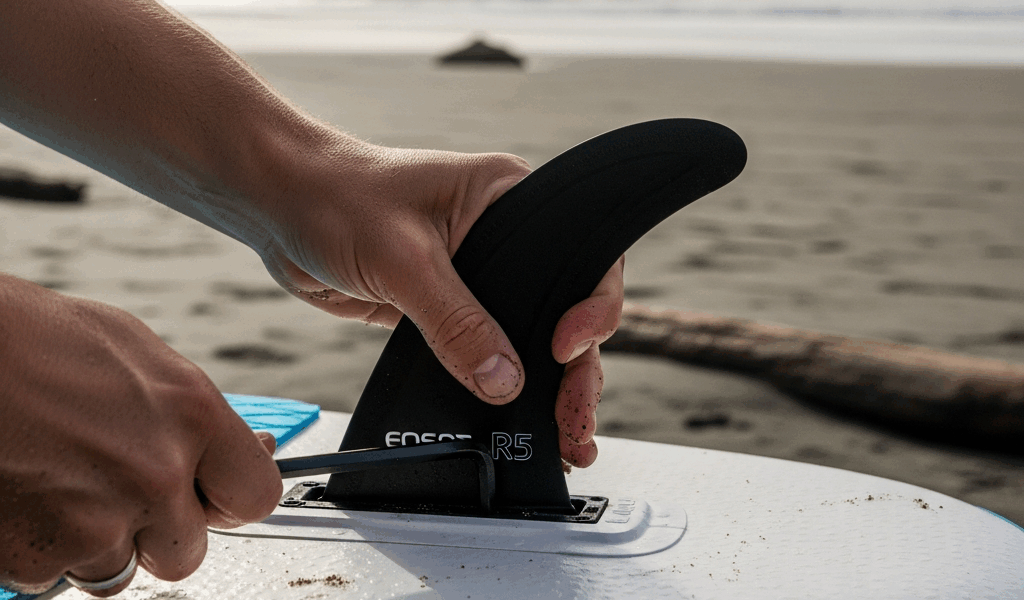
Step 1 — Grab a fin key or flathead screwdriver. Slide the fin to position in the box, then tighten the plate bolt until it resists movement. You shouldn’t need to force it — hand-tight plus a firm quarter turn is usually right. Over-tightening cracks the plate.
If it’s still loose after tightening — the channel itself has worn and the fin base has play in it. Two things work here:
- Shim method: Cut a thin strip of plastic from an old container lid or a credit card you don’t need — about 1cm wide, as long as the fin base. Slide it into the channel alongside the fin base before tightening. Eliminates the slop. Trim to fit.
- Wax method: Rub surf wax or a plain household candle along both sides of the fin base before inserting. The wax fills micro-gaps and gives it friction to grip. Reapply every few sessions as it wears off.
If the slop is significant, go with the shim. If it’s just a little bit of wiggle, wax is quicker and works fine.
Fix for Snap-Lock Fins (iRocker, Gili, Aqua Marina)
No-tool systems fail for specific mechanical reasons. Look before you do anything else.
Check the plastic lever or cam on the fin box. If it’s cracked or the locking tab has snapped, the fin won’t stay regardless of what you do to it — that’s a part replacement. Contact the brand, or search for a compatible replacement fin set on Amazon. iRocker and Gili both sell their own through their sites and Amazon.
If the lever looks fine, check the fin base tab — the small plastic nub that clicks into the lock. If it’s worn flat or chipped, there’s nothing for the mechanism to grip. Same answer: replacement fin.
If both look intact but the fin is just slightly loose, check for small Phillips screws on the fin box body itself. Some snap-lock systems have these and they loosen after regular use. A screwdriver and thirty seconds usually fixes it.
Fix for Screw-Tab Fins (Tobin Sports, Body Glove, Most Costco Brands)
The screw-tab system has two things that fail: the screw and the brass insert it threads into. Figure out which one is the problem before reaching for tools.
If the screw won’t tighten — threads have stripped. Stop turning it; you’re just making it worse. Hardware stores carry M4 and M5 stainless screws that fit most Costco fin tab systems — try the next size up with the same thread pitch. Stainless is worth the upgrade anyway; the original hardware rusts in saltwater.
If the insert spins freely — the brass insert the screw threads into has pulled loose from the board material. Deflate completely, let it dry thoroughly, then apply a small amount of marine epoxy around the insert base, press it back into position, and give it 24 hours before you inflate again. Don’t rush the cure. Done right, this fix holds through multiple seasons.
Keep a spare fin and a basic repair kit in your dry bag. The hardware on screw-tab systems is small and easy to lose on a beach.
When the Fin Box Itself Is Damaged
Sometimes it’s not the fin — it’s the box mounted to the board. Here’s what box failure looks like:
- Visible cracking or splitting around the box lip or mounting ring
- Water pooling at the fin area after paddling — the seal around the box is going
- Fin sits loose even with a brand-new fin inserted — the box geometry is gone
If you’re inside the warranty window (most inflatable SUP brands do 1-2 years), contact the manufacturer before touching it — a cracked box is often covered and they’d rather send a replacement than have a bad review. Out of warranty, US box repairs are doable with a replacement box and SUP repair adhesive, but it’s a bigger job than a fin swap. For this one, a local SUP shop is worth the cost.
Preventing Fin Problems — Before Every Session
Most fin problems develop from gradual wear and neglect, not sudden failure. Three habits eliminate most of them:
- Rinse the fin and fin box with fresh water after every use. Especially after saltwater. Salt and grit inside the box grind against the fin base and channel walls every time the board flexes on the water — it’s slow damage, but it adds up.
- Check tightness before every launch. Five seconds. Fins work loose over repeated sessions and the board’s flex on the water accelerates it. You won’t always feel the looseness until the board starts pulling sideways mid-paddle.
- Pull the fin out before rolling the board for storage. Storing an inflatable with the fin installed and compressed in a bag puts constant sideways stress on the fin box. After one winter of this, fins stop seating correctly even if nothing is visibly broken.
None of this takes more than a minute. It’s the difference between a fin system that lasts three seasons and one that needs replacing after the first.