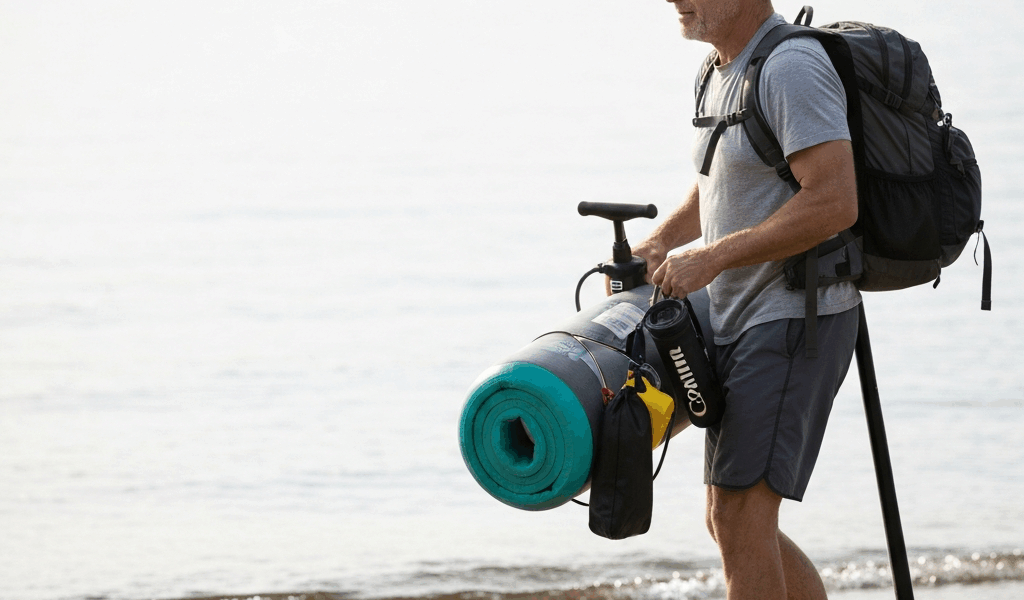
Both show up in the Costco SUP section at the same price point — sometimes literally next to each other. If you’re trying to pick between the Body Glove Performer and the Tobin Sports Endeavor Elite, here’s the comparison with an actual verdict at the end.
Side-by-Side Specs
| Spec | Body Glove Performer 11′ | Tobin Sports Endeavor Elite 11’2″ |
|---|---|---|
| Length | 11′ | 11’2″ |
| Width | 31″ | 32″ |
| Weight Capacity | 275 lbs | 353 lbs |
| Construction | Clear Tek Drop-Stitch | Tritech Triple-Layer Stringer |
| Fin System | Snap-in center + side fins | Screw-tab fins (3 included) |
| Pump Included | Electric (Body Glove GTS) | PowerGrip Sport Electric |
| Target PSI | 12–15 PSI | 15 PSI |
| Price (Costco) | ~$349–399 | ~$349 |
Two numbers do most of the work: width (31″ vs 32″) and weight capacity (275 lbs vs 353 lbs). Everything else is close enough that it doesn’t drive the decision.
Stability — Which Is Better for Beginners?
The Tobin wins here, and it’s not a close call.
One inch of width sounds like nothing until you watch a nervous first-timer trying to find their footing. Beginners stand wider than experienced paddlers, shift their weight more, and overcorrect constantly. The 32-inch Tobin gives them more platform to work with. On flat water — Green Lake, a calm Cascade lake, a protected Puget Sound bay — that inch is the difference between “I’ve got this” and “I’m about to fall in.”
The weight capacity gap is the bigger deal. Body Glove’s 275 lb limit is standard for budget boards. Tobin’s 353 lbs is unusually high for this price. That matters if you’re over 200 lbs and want the board to sit high rather than wallow, if you want to bring a dog, or if there’s any chance two people will share the board. At 275 lbs, an average adult with a light day bag is already at the Body Glove’s limit. The Tobin has room to spare.
Build Quality — Tritech vs Clear Tek Drop-Stitch
Both boards use marketing names for their construction — Tobin’s “Tritech” and Body Glove’s “Clear Tek Drop-Stitch” both claim triple-layer reinforcement. At 15 PSI both feel solid enough for recreational paddling. Neither will match the rigidity of an iRocker or a Bluefin at double the price, and the practical difference between the two Costco boards in stiffness is minimal.
Where the Body Glove actually has an edge: it’s been in Costco’s lineup significantly longer. That means more reviews, more forum threads, more documented fixes when things go wrong. If your valve starts leaking or a fin strip, there’s a higher chance someone has already posted a solution for the Body Glove. For first-time board owners, that support network has real practical value — the Tobin is too new to the Costco rotation to have the same depth.
Both boards are covered by Costco’s 90-day return policy. That substantially reduces the risk on either choice — if something’s wrong, you can return it without a complicated process.
What’s Included — Pump, Paddle, Bag Quality
The Tobin’s PowerGrip Sport electric pump is better. It gets consistently higher marks across user reports than the Body Glove GTS pump — more reliable inflation, cleaner auto-shutoff at target PSI, and better performance over repeated uses. Both are 12V pumps that plug into your car’s outlet, but the PowerGrip Sport handles the job more dependably.
Paddles on both boards are aluminum shafts with plastic blades. Functional. Not impressive. If you find yourself on the water more than a handful of times per season, a carbon fiber paddle upgrade makes a real difference in arm fatigue — the weight savings over two hours adds up. Both carry bags have backpack straps with no padding, fine for a short haul to the water.
Neither board includes a leash. Pick up a coiled SUP leash before your first session. In Puget Sound cold water, staying connected to your board when you fall isn’t optional.

Which Should You Buy?
Buy the Tobin Sports Endeavor Elite if you’re a first-time paddler, you’re heavier than 200 lbs, you plan to paddle with a dog or carry gear, or you’re buying for a household with mixed experience levels. The wider board, higher weight capacity, and better pump add up to a stronger package at the same price. This describes most buyers in the Costco aisle.
Buy the Body Glove Performer if you’ve paddled before and want the slightly more maneuverable feel of a narrower board, or if you specifically want a board with years of community reviews and troubleshooting threads behind it. The 31-inch width that’s a disadvantage for beginners is a mild advantage once you have enough experience to use it.
Remember that Costco’s 90-day return policy applies to both. If you get either board on the water a few times and decide it’s not the right fit — wrong size, wrong feel, paddleboarding just isn’t for you — you can return it. That’s a very different risk than buying from a brand where returns involve shipping labels and 30-day windows.
One honest note for both: if you end up paddling 20+ sessions a season, you’ll start hitting the limits — tracking, flex in chop, basic accessories that need replacing. At that point the iRocker Cruiser at $599–699 is the upgrade worth making. Both Costco boards are try-it boards. The Tobin is the better one.
What About Other Costco Water Sport Options?
Costco occasionally carries the Tommy Bahama 2-in-1 kayak/SUP hybrid — a board that converts between paddleboard and sit-on-top kayak configurations. If your household wants flexibility between paddle styles, it’s worth watching for. The tradeoff is a board that’s optimized for both uses but best at neither.
One thing worth knowing: Costco SUP inventory is seasonal. Both the Body Glove and Tobin boards typically land in late winter through spring. By summer they’re often sold out or replaced. If you’re seeing them in stock now, that’s the buying window.