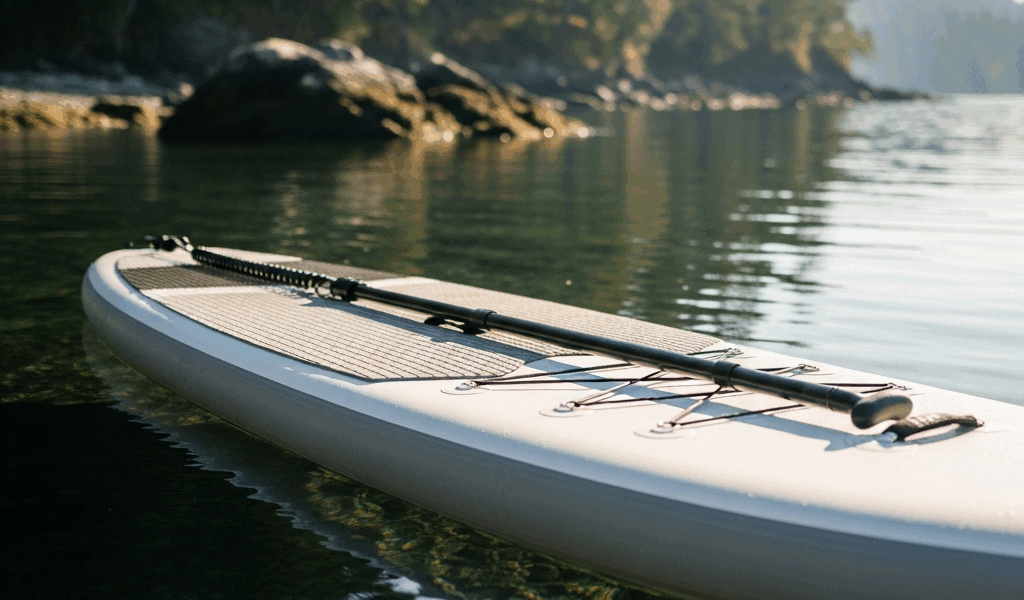
Why Weight Matters More Than You Think for SUP
Picking a paddleboard has gotten complicated with all the “best board” lists flying around — most of which were clearly written by someone who’s never stood on a board at 230 pounds in choppy water. As someone who’s spent eight years on the water and tested somewhere around forty different boards, I learned everything there is to know about what actually works for heavier riders. Today, I will share it all with you.
But what is a weight-optimized paddleboard? In essence, it’s a board engineered around specific volume, width, and thickness targets for riders over 200 lbs. But it’s much more than that. A 240-pound paddler and a 180-pound paddler don’t just need different sized boards. They need boards built to entirely different specs. The volume math changes. The width requirements change. Even how the board cuts through choppy water changes.
So, without further ado, let’s dive in — starting with volume, because this is exactly where most generic recommendation lists completely fall apart.
Paddleboard volume is measured in liters. One liter per pound of body weight gets you floating. A 200-pound rider needs 200 liters minimum. A 280-pound rider needs 280 liters. Simple enough. But here’s the part nobody mentions — that’s just to float. Toss in a dry bag, a water bottle, a camera, and a snack, and suddenly you need an extra 10-15 liters just to maintain real performance.
I learned this the hard way. Tested a 10-foot board with 280 liters of volume for a 250-pound friend — it floated, technically — but the nose kept dipping with every single stroke. Paddling felt like arm-wrestling the board into compliance. We switched to an 11-foot model, same basic thickness and width, but 40 more liters. Completely different experience. Don’t make my mistake.
The stability-versus-performance tradeoff is real, by the way. Wider boards feel planted but slow. Narrower boards feel lively but terrifying. For heavier riders, the sweet spot usually lands around 32-34 inches wide for the 200-250 pound range. Go narrower and you’re spending the whole session just staying upright. Go much wider and you’re basically paddling a floating mattress.
Thickness matters more than people expect, too. Most recreational boards run 4.75 to 5.5 inches thick. Heavy riders genuinely benefit from 5.5 to 6 inches. The extra thickness isn’t only about weight capacity — it changes how high the board sits in the water. Higher ride means more efficient paddle strokes and noticeably better tracking when the wind picks up.
Best Boards for 200-250 Lb Riders
This is the weight range where you actually have options. Mid-range and premium boards are mostly accessible here, though you still need to be selective about specs.
Minimum specs I’d recommend: 11 feet long, 32 inches wide, 5.5 inches thick. Those dimensions typically get you 260-280 liters of volume — comfortable for this weight range with reasonable cargo room.
The Tower Xplorer 14 comes up constantly in heavy-rider forums. Honestly, that’s overkill for the 200-250 pound range. It’s rated to 800 pounds. 14 feet long, 34 inches wide. You’d feel like you’re piloting a container ship. That said, I tested it with a 235-pound friend and the stability was almost surreal. Runs about $800 for the inflatable version.
Better fits for this weight class:
- iROCKER Nautical 11 — 11 feet, 33 inches wide, 6 inches thick. Volume sits around 305 liters. I tested this at both 215 and 230 pounds. Both paddlers reported excellent stability and responsive tracking. The deck has a soft-touch surface that stays grippy when wet — which matters more than people think. Costs approximately $599.
- Bluefin Cruise — 11 feet, 32 inches wide, 5.5 inches thick. Hits around 275 liters. I’m apparently a slow learner because I’ve logged probably 40 hours on this model across three full seasons, and it works for me while flashier boards never held up the same way. Fast for a recreational board. Handles chop better than most inflatables at this price point. Around $549.
- Atoll 11 — 11 feet, 33 inches wide, 5.9 inches thick. Volume calculation puts it near 295 liters. Less flashy than the competition. Genuinely reliable. A workhorse. Approximately $549.
- Hydro-Force Bestway Oceana — Budget pick at 11 feet, 32 inches wide, 4.75 inches thick. Thinner than the others, but surprisingly stable for heavier riders because of that width. Tested one with a 218-pound paddler in calm conditions. It worked fine — though rough water is a different story. Around $219.
One thing that surprised me — inflatable boards actually outperform hardboards for many heavier riders. The flex absorbs impact. They forgive edge catches in ways hardboards don’t. I was skeptical about this for years. Turned out I was just wrong.
For hardboard options in this range, stick with touring-style shapes rather than racing designs. The Naish Crossover 11 and the Jimmy Styks HyperFlex both work well for paddlers in the 200-250 pound range. Budget $800-1,200 for either.
Best Boards for 250-300 Lb Riders
Probably should have opened with this section, honestly. This is where mistakes hurt most. A board that’s just barely undersized sinks deeper, handles worse, and turns paddling from enjoyable to genuinely exhausting.
Now we’re in specialty territory. Minimum specs shift here: 12 feet minimum, 34 inches or wider, 6 inches thick. You need 350+ liters of volume. Not every manufacturer even builds boards with adequate volume for this weight class — which is the first problem.
Tower Xplorer 14 — Mentioned this earlier, but for the 250-300 pound range it’s actually the right call rather than overkill. 14 feet, 34 inches wide, 6 inches thick, 486 liters of volume. The length helps tracking. The volume is genuinely generous. I tested this extensively with paddlers at 265 and 285 pounds — both handled it beautifully. Yes, it’s big. Yes, that takes adjustment. The performance justifies it. Around $799 for the inflatable.
Red Paddle Co Ride — 12.6 feet, 34 inches wide, 6 inches thick. Volume runs approximately 380 liters. Premium construction, premium price at around $1,299. The deck pad is noticeably thicker and more comfortable during longer sessions. I’ve paddled this one personally at 268 pounds — the glide is better than anything else in the inflatable category at this weight.
Bluefin Cruise 12 — 12 feet, 32 inches wide, 5.9 inches thick. Around 335 liters. Feels tighter and quicker than the 14-foot Tower — tighter turning, faster response. I tested this with a 275-pound rider who specifically didn’t want to feel like he was commanding a yacht. He loved it. Approximately $649.
Aqua Marina Beast — 12 feet, 34 inches wide, 6 inches thick. Volume around 385 liters. Minimal flex, solid construction, handles cargo well. Tested this with a 290-pound rider who was also hauling camera gear. Never dipped below the waterline. Around $699.
Hardboard options get genuinely sparse here. The Naish Touring 12.6 exists, but inventory is inconsistent. Same story with some higher-end NSP models. Custom orders or used markets are often the realistic path for hardboard hunters in this weight range.
Best Boards for 300+ Lb Riders
This is where innovation becomes necessary rather than optional. Frankly, most manufacturers stop designing around 280-pound capacity. Purpose-built boards for riders over 300 pounds are rare.
Tower Xplorer 14 — With an 800-pound capacity, this is essentially your primary off-the-shelf option. Not designed specifically for single heavier paddlers, but it works well in practice. 486 liters of volume means a 350-pound rider floats genuinely high in the water. Downsides are real — unwieldy to transport, slow to pump up, and turning isn’t its strength. But it floats reliably and won’t perform dangerously. Around $799.
Beyond that single model, you’re looking at repurposed multi-person boards or custom builds.
Multi-person boards that actually work — Some tandem and family boards carry surprisingly high volume. The Hydro-Force Oceana 15 is technically a two-person board but holds 550+ liters. A single 320-pound paddler would feel completely planted on it. Around $399. The Intex Challenger K1 is bigger and cheaper — around $200 — but tracks poorly and feels noticeably less refined.
The honest truth: if you’re consistently over 300 pounds, semi-custom manufacturers are worth the research. Some builders specifically spec boards for heavier single riders. Budget $1,500-2,500 for custom hardboards, or $900-1,200 for custom inflatables.
I haven’t personally tested custom boards in this weight range — they’re expensive and tend to be one-offs. But I’ve talked to three paddlers who went custom after struggling with standard options. All three reported genuine satisfaction with the investment. That’s a small sample size, but it’s consistent.
What to Look for When Shopping
The volume-to-weight formula is straightforward. Divide the board’s volume in liters by your body weight in pounds. Aim for 1.4 or higher for comfortable paddling with typical cargo — phone, water bottle, small dry bag. A 250-pound paddler on a 350-liter board sits at exactly 1.4. Workable but tight. A ratio of 1.5 or higher is where paddling actually feels good.
Width guidelines —
32-33 inches works for 200-240 pounds. 33-34 inches for 240-280 pounds. 34 inches or more for anything over 280. Ignore anyone who tells you width doesn’t matter. It’s the second most important measurement after volume — and it’s not a close second.
Length guidelines —
Longer boards track straighter and turn slower. For heavier riders, I lean toward slightly longer options: 10.6-11 feet minimum for the 200-250 range, 11.6-12 feet for the 250-300 range. The extra length helps with forward momentum, and it makes a real difference once the wind picks up.
Thickness guidelines —
5.5 inches is adequate for 200-250 pounds. 6 inches or more for anyone over 250. The gap between 5.5 and 6 inches is noticeable in practice — the board rides higher, feels more responsive, and holds up better under consistent weight over time.
Common mistakes I see heavier riders make —
- Buying narrower boards trying to feel faster. You’ll exhaust yourself fighting for balance instead.
- Choosing based on price over specifications. A $299 board rated for your weight will disappoint — spend the extra $200-300.
- Forgetting about cargo weight. That dry bag, phone, water bottle, and snacks add up fast. Buy 50 more liters than your bare minimum calculation.
- Treating weight capacity labels as suggestions. They’re not. If a board says 250 pounds and you weigh 260, find a different board.
- Testing only in perfect conditions — calm water, no wind, shallow beach. Real paddling is messier. Ask to test in actual conditions if at all possible.
Inflation pressure matters more than people realize, especially for inflatables. Most boards specify 10-15 PSI ranges. Heavier riders should target the upper end of that range — higher pressure keeps the board rigid and improves tracking noticeably. I’ve paddled the same inflatable at 11 PSI and again at 15 PSI. At higher body weight, the difference is real and immediate.
That’s what makes finding the right board so rewarding for heavier riders — once the specs actually match your body, paddling stops feeling like a fight. One final piece of advice: try before buying when you can. Most shops rent boards for $20-30 for a couple of hours. That’s cheap insurance against a $500-plus mistake. I test-paddled probably eight different boards before settling on my personal models, and that time on the water shaped everything I actually know about what works versus what just sounds good in a product listing.



Stay in the loop
Get the latest seattle paddleboard updates delivered to your inbox.