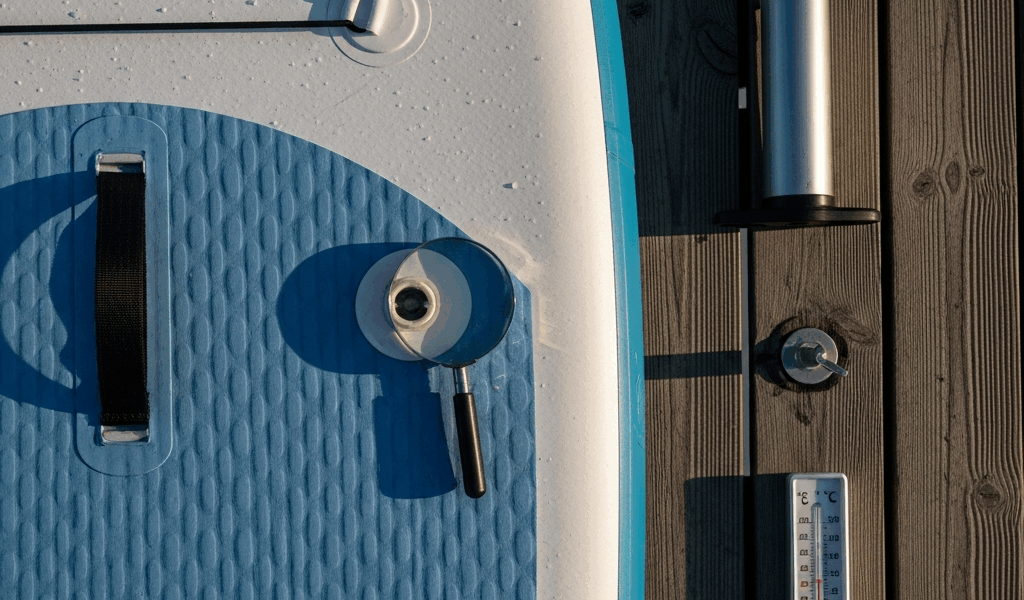
How Much PSI Loss Is Actually Normal
Inflatable paddleboard ownership has gotten complicated with all the conflicting advice flying around. Lose a little air overnight and suddenly every forum thread is telling you your board is destroyed. Before you spiral, here’s what you actually need to know: some PSI loss is completely normal — and it has nothing to do with a leak.
As someone who spent five years troubleshooting inflatable boards along the Pacific Northwest coast, I learned everything there is to know about temperature-related pressure loss. Today, I will share it all with you.
Temperature is almost always the culprit. For every 10°F drop, your board will naturally shed about 1–2 PSI. Pure physics. The air inside contracts as it cools.
Here’s a real example. You pump your board to 15 PSI at 70°F on a Tuesday evening. Wednesday morning in Seattle, it’s 50°F. Your gauge reads 12–13 PSI. That 2–3 PSI drop? Completely normal. Nothing broke. No one’s to blame.
The air molecules slow down in colder temps — they don’t escape, they just take up less space inside the chamber. Once your board warms back to 70°F mid-morning on the water, that pressure climbs right back to 15. You’ll see it happen in real time.
Probably should have opened with this section, honestly. It would save a lot of people a lot of unnecessary panic.
The diagnostic question worth asking yourself: did the board lose more than 3–4 PSI overnight, or did the temperature just drop significantly? If your area went from 65°F down to 45°F and you’re missing 3 PSI, you’re fine. If your board lost 8+ PSI on a stable-temperature night, then yes — you’ve got an actual leak. Keep reading.
How to Tell If You Have a Real Leak
The soapy water test is your gold standard here. That’s what makes this method endearing to us paddleboard owners — it costs almost nothing and gives you a definitive answer. So, without further ado, let’s dive in.
While you won’t need any specialized equipment, you will need a handful of basic supplies: a spray bottle, dish soap, and water. Mix roughly one tablespoon of dish soap into a standard 16-ounce spray bottle filled with water. Dawn works fine. Generic store-brand dish soap works fine. Don’t overthink it.
First, you should inflate your board to its recommended PSI — at least if you want accurate results. That number is usually printed on the valve itself or inside the manual. Most quality boards run somewhere between 12–18 PSI. My Bluefin 10’8″ runs best at 15, for reference.
Then spray every inch of the board. Methodically. Don’t rush this part.
Watch for bubbles. A real leak produces visible bubbles that grow and pop in a repeating cycle — it’s not subtle. If air is escaping, the soapy water will show it within seconds.
The valve should be your first stop. Spray the stem, the base, and the full valve assembly. Valve leaks are the most common failure point by a wide margin — the core loosens over time, or the seal wears out from repeated use. Many boards ship with a small valve wrench tucked in the bag (flat-head slot, looks almost like a tiny screwdriver). Check your manual before assuming yours didn’t come with one. I lost mine for six months before finding it zippered into a pocket I’d ignored.
Next, work along every seam — the rails, nose, tail, anywhere two panels of material meet. Seam leaks tend to show up as a slow ring of small bubbles rather than one dramatic burst point. Five tiny bubbles forming around a two-inch stretch of rail is still a leak. Don’t dismiss it.
Finally, check the flat deck and the underside of the board. Leaks here are less common, but not impossible — especially if the board has taken a hit from something sharp.
No bubbles anywhere, and your overnight loss is only 2–3 PSI with a temperature drop? You don’t have a leak. Go paddle.
Fixing a Leaky Valve in 5 Minutes
Most paddleboard air loss starts at the valve. Two problems cause this: a loose valve core or a worn valve seat. But what is a valve core? In essence, it’s the small threaded insert inside the valve housing that controls airflow. But it’s much more than that — it’s also the piece most likely to work itself loose after a season of use.
Start by trying to tighten it. Grab your valve wrench — or a quarter if you’ve misplaced the wrench, since most cores have a flat slot that accepts a coin. Turn clockwise until you feel snug resistance. That’s when you stop. Don’t muscle it.
Re-inflate and run the soapy water test again. If there are no bubbles now, you fixed it. A loose valve core accounts for roughly 60% of the valve leaks I’ve personally diagnosed. That was always my first guess, and it was right more often than not.
If tightening didn’t solve it, the valve seat itself might be worn. Here’s a quick test: inflate the board fully, then gently press down the valve pin — the small stem at the center of the valve. If air rushes out and keeps flowing after you release your finger, the seat isn’t sealing. That’s your problem.
Replacement valve cores run under $10 and are brand-specific, so don’t grab a generic one. Check your board’s manual or the manufacturer’s site directly. Installation takes about two minutes — unscrew the old core, thread in the new one by hand, then snug it down with the valve wrench. Done.
I’m apparently someone who goes through valve cores every 18 months, and the brand-specific replacements work for me while generic hardware store substitutes never seal correctly. Don’t make my mistake.
If the board is still leaking after a fresh core, the valve housing itself is damaged. That’s warranty territory. Most manufacturers sell replacement valve assemblies for $15–$30, and many will send one free under warranty if the board is less than a year old.
Patching a Seam or Body Leak at Home
Found bubbles on a seam or the board body? You can handle this yourself — assuming you have the right repair kit. Most boards are built from PVC material and need a PVC-compatible adhesive. Some higher-end boards, like certain Red Paddle Co. and Naish models, use Hypalon — which requires a completely different glue. Check your manual before buying anything. Using the wrong adhesive is a fast way to waste an afternoon.
Here’s the exact process I use:
- Deflate the board completely. All the way down. Pressure in the chamber will fight your patch and prevent a clean bond.
- Dry the repair area thoroughly. Towel it off, then let it air dry for another 10–15 minutes. Water kills adhesive bonds.
- Lightly rough the surface with fine-grit sandpaper — usually 120 or 150 grit, and most patch kits include a small square. You’re not trying to sand through the material. Just dull the glossy finish so the glue has something to grip.
- Apply PVC adhesive to both the board surface and the patch itself. Most kits include a small applicator brush. Wait 30–60 seconds for the adhesive to turn tacky — sticky to the touch, not wet-looking.
- Press the patch firmly onto the board and hold it hard for a full 60 seconds. No wiggling. No adjusting. Commit to the placement before you make contact.
- Let the adhesive cure for at least 24 hours before putting any air back in the board. I usually wait 36 hours if the weather is cool.
Common mistakes I see: patching a cold board (adhesive won’t cure properly below 50°F), pulling the patch off to reposition it after contact, and using the wrong glue for the material. That last one is the most expensive mistake.
Seam leaks along the rail tend to need a bigger patch than people expect. I recommend going at least 4 inches long for any seam repair — small patches peel up fast, especially at the edges where flex stress concentrates. Bigger is better here.
When to Stop Fixing and Contact the Brand
If your board is still losing more than 5 PSI overnight after you’ve ruled out temperature — and you genuinely cannot find a leak source with soapy water — you’re probably looking at an internal bladder failure or delamination between layers. That’s not a DIY fix. Full stop.
Frustrated by the vague advice most forums give at this point, I once spent three weekends trying to patch a board that had internal delamination using every method I could find online. Nothing held. The board needed warranty service the whole time.
This new reality took off several years later in the inflatable SUP world and eventually evolved into the clear return policy and warranty structure enthusiasts know and rely on today. Most quality brands now offer 1–2 year warranties covering seam failures and material defects — and they’ve gotten reasonably good at honoring them.
Red Paddle Co., Bluefin SUP, Naish, and Aqua Marina all maintain warranty claims pages on their sites. Have your serial number ready before you reach out — it’s usually on a label near the valve or printed directly on the deck. The claim process typically takes less than 15 minutes to initiate.
A legitimate seam failure under warranty usually results in a free repair or full replacement. It’s absolutely worth pursuing before you write the board off or spend money on a new one.



Stay in the loop
Get the latest seattle paddleboard updates delivered to your inbox.