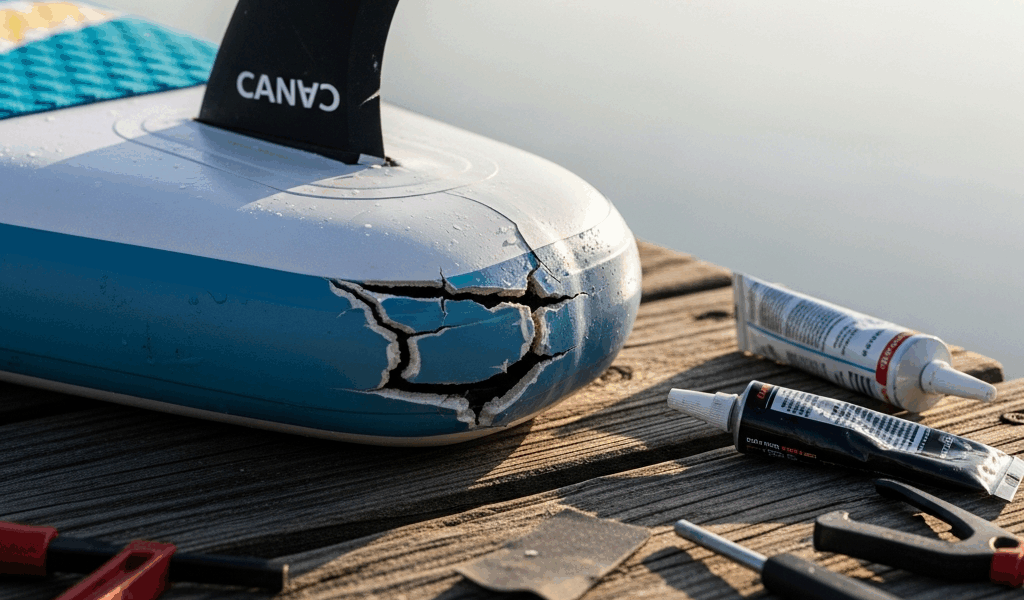
How to Tell If Your Fin Box Is Actually Cracked
This article includes affiliate links. We may earn a commission at no extra cost to you.
Paddleboard fin box repairs have gotten complicated with all the conflicting advice flying around. You’re either crouched over your board in the garage or squinting at it in the parking lot after a session, wondering if your season just ended. It hasn’t. Probably. But let’s figure out what you’re actually dealing with before you panic or, worse, ignore something real.
Three things tell you something’s wrong. First, grab a flashlight and shine it straight down into the slot where your fin slides in. Look for a hairline crack running along the slot walls. Thin. Dark. Definitely not part of the original molding. If it’s there, you’ll see it.
Second, leave the fin installed and try to wiggle it side to side. A healthy box doesn’t move — at least not even a millimeter. If it rocks like a loose tooth, the bond between the box and the board has separated. On inflatables especially, that separation is almost always the actual problem, not a crack in the plastic itself.
Third, on hollow hard boards, check the deck around the base of the fin box after a session. Water pooling there means the crack has broken the seal. Not a drop-everything emergency. But not something to ignore for another three weekends either.
One thing people consistently miss: a cracked box is not the same as a stripped screw channel. Stripped means the plastic threads are gone — your fin screw just spins or won’t cinch down. A genuine crack is structural damage to the box walls. The wiggle test catches this instantly. Do the wiggle test first.
Inflatable SUP Fin Box vs Hard Board — the Fix Is Different
Probably should have opened with this section, honestly. The repair changes completely depending on what kind of board you have, and most guides online treat them like the same problem. They’re not.
On an inflatable paddleboard, the fin box isn’t molded into the board. It’s a separate plastic component bonded onto the outside of the PVC bladder — usually with marine adhesive during manufacturing. When an inflatable’s fin box “cracks,” what you’re almost always looking at is bond failure. The box and the bladder have separated from each other. The plastic box itself is probably fine. This is a garage fix. No special tools required.
On a hard board — foam core with fiberglass shell, epoxy composite, whatever — the fin box is glassed directly into the structure. It’s not bonded on top of anything. It grew out of the board during the build. A crack there is a structural issue that can propagate into the deck itself if left alone. Sometimes that’s a shop repair. No way around it.
Flip your board over to figure out which situation you have. On an inflatable, you’ll see the PVC bladder with the fin box sitting on top of it — two clearly separate components. On a hard board, you’ll see glass fibers and resin wrapping continuously around the box. It looks like one piece. That’s because it is.
I’m apparently someone who paddles Puget Sound year-round, and cold saltwater accelerates bond failure faster than someone paddling in Southern California water would ever notice. Temperature cycling, UV, constant PVC flex — the adhesive fatigues. I went through this with an iROCKER Cruiser 10 after two winters. The box wasn’t cracked. The bond was just done.
Step-by-Step Fix for an Inflatable Paddleboard Fin Box
While you won’t need a full fiberglass repair kit, you will need a handful of things: 120-grit and 220-grit sandpaper, PVC cement or your board’s branded adhesive, a small applicator brush, and patience — genuinely, patience is the main ingredient here.
First, you should remove the fin completely — at least if you want the repair to actually hold. Unscrew it and set it somewhere it won’t roll off your workbench. Clean the entire fin box area with fresh water. Let it dry. Fully. This is where most DIY repairs fall apart. Salt residue and moisture left on the surface will prevent the adhesive from bonding properly. Don’t rush this step.
Sand the bond line where the box meets the PVC bladder using 120-grit paper. You’re creating mechanical texture, not removing material. Fifteen seconds of light passes is enough. Wipe away all dust with a barely damp cloth. Let it dry again — 20 minutes minimum.
Brand-specific repair kits might be the best option here, as this repair requires adhesive formulated for the exact PVC compound your board uses. That is because generic hardware store cement sometimes cures too rigid for PVC that needs to flex with every stroke. Red Paddle Co’s kit and iROCKER’s bonding system both work well in my experience. If you’re going generic, use a flexible PVC cement — Christy’s R-MV or similar — and apply a thin bead along the full separation line. Press the box firmly for 60 seconds.
Don’t make my mistake. I reinstalled an iROCKER fin 18 hours after gluing in 58-degree Seattle weather. The bond failed two sessions later. In the Pacific Northwest, give it 36 to 48 hours minimum. Humidity slows the chemical cure significantly. 24 hours is fine for Phoenix. Not here.
Once it’s cured, reinstall the fin and do the wiggle test again. Zero movement means you’re done. Any rocking means the separation was too extensive — take it to a shop.
Step-by-Step Fix for a Hard SUP Fin Box
Surface hairline crack with no water intrusion? You can handle this yourself. Box pulling away from the deck, or crack running deeper than the surface layer? That’s a shop job. Knowing which one you have is the whole ballgame.
For a surface crack: clean the area and let it dry completely. Sand around the crack with 220-grit paper — just enough to remove any loose or flaking fiberglass. Use a toothpick or small applicator to work two-part marine epoxy into the crack. West System 105 with 205 hardener works well here. Slightly overfill it. Let it cure the full 24 hours.
Sand the cured epoxy flush using 220-grit, then finish with 320-grit. Run your finger across it. Smooth and solid means you did it right. Reinstall the fin, do the wiggle test, go paddle.
For a box separating from the deck: this requires re-glassing, and re-glassing requires a shop. Seattle has good options — local board builders in West Seattle handle this regularly, and several dedicated paddle shops around the Sound do fin box work. Expect to pay somewhere between $80 and $150 depending on how bad the separation is. That is genuinely worth it. A board failure mid-session in Puget Sound cold water is not a situation you want to be in.
How to Prevent the Fin Box From Cracking Again
Don’t overtighten the fin screw. I know the instinct. Finger-tight plus one-quarter turn is the actual sweet spot — at least if you want the box walls to survive more than two seasons. The fin won’t move. Trust it.
Rinse the board with fresh water after every Puget Sound session. Salt crystallizes in the bond line and degrades adhesive over months. Five minutes in the parking lot with a jug of water. That’s all it takes.
Store the board fin-side up when possible. Water that gets into a fin box should drain toward the board, not pool inside the box itself. Small thing. Adds up over a winter.
Do the wiggle test once a month during the paddling season. Catch separation early — when it’s a $6 tube of PVC cement — rather than late, when it’s $120 at a shop.
A properly repaired fin box holds for years. This is a fixable problem, not a new board problem. Don’t let it ruin your season.




Stay in the loop
Get the latest seattle paddleboard updates delivered to your inbox.