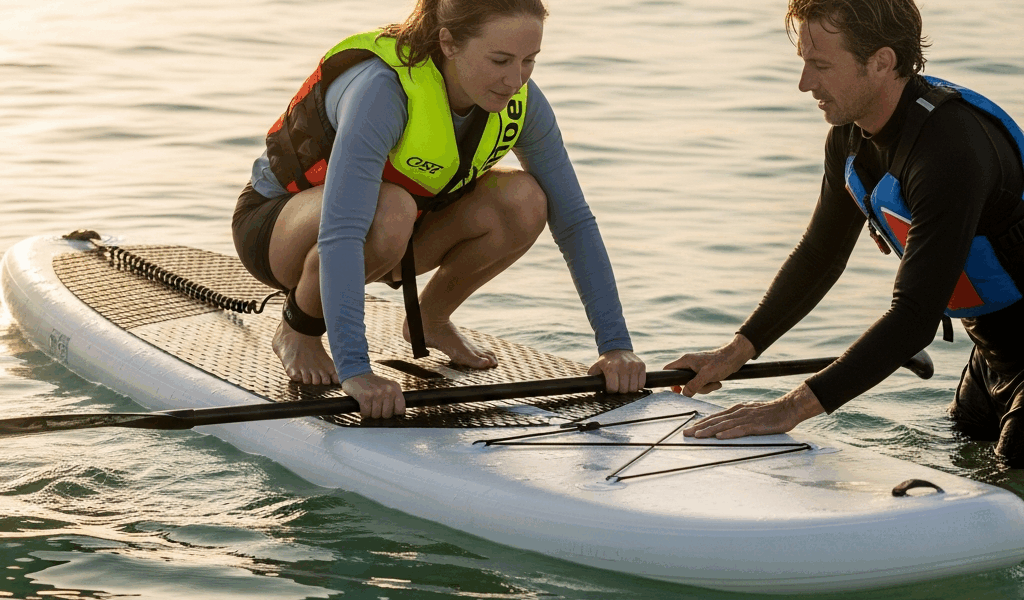
Paddleboard Falling Off — How to Stay Balanced as a Beginner
Learning to paddleboard has gotten complicated with all the conflicting advice flying around. As someone who spent fifteen years teaching stand-up paddleboarding, I learned everything there is to know about why beginners fall — and more importantly, how they stop falling. Today, I will share it all with you.
Here’s the thing most people don’t talk about: the falling doesn’t happen while you’re getting up. You stand, you feel solid, maybe you even smile at whoever’s watching from the shore. Then, three strokes later, you’re underwater again wondering what went wrong.
That’s the real frustration. Not the initial wobble — the unexpected swim after you thought you had it figured out.
I fell plenty myself when I was learning. Usually in front of people I was trying to impress, naturally. But the gap between staying on and ending up in the water comes down to a handful of specific, fixable habits — nothing mysterious, nothing that requires extraordinary athletic ability.
The #1 Reason Beginners Fall Off — Look Up, Not Down
Every single time someone loses their balance on my watch, the sequence is identical: chin drops, eyes lock onto the board, and it’s over within seconds.
Probably should have opened with this section, honestly.
Terrified beginners stare at their own feet. They’re watching the board flex beneath them, clocking every tiny movement, and the brain decides that movement means danger. Body tenses up. Weight shifts forward. Into the water they go.
But what is the real culprit here? In essence, it’s a sensory conflict. But it’s much more than that — your eyes actually run the show when it comes to balance, far more than your legs ever could. Your inner ear is desperately trying to level itself with the horizon while your eyes are screaming that the world is tilted sideways. Those two signals fight each other. The eyes usually win. That’s bad news when you’re staring at a moving board.
Find something stable and far away. The opposite shoreline. A dock. A tree line. Keep your gaze at eye level or above — never below the horizon.
I had a student named Marcus who improved his balance by around 40% in a single session just by changing where he looked. Same board. Same water. Same everything. Just his eyes pointed somewhere useful instead of straight down at his feet. That was during a Tuesday morning lesson in August 2019, and I still think about it whenever someone tells me balance is about leg strength.
The other beginner killers are simpler to fix once you’ve got your eyes sorted:
- Feet too close together — Your feet should be roughly shoulder-width apart. Narrow stance feels completely natural on solid ground. On water it’s a disaster. The board rocks beneath you and a narrow base has no capacity to absorb that movement — at least not without throwing you sideways.
- Stiff knees — Bend them slightly. Think shock absorbers, not stilts. Locked knees send every ripple straight up through your hips and into your upper body, amplifying the instability instead of damping it.
- Hunching your shoulders — Tension travels down the body. Tight shoulders create tight hips. Tight hips mean your weight is frozen in place rather than moving naturally with the board beneath you.
Foot Placement That Actually Works — Parallel Stance Wins
Let me be specific here, because I’ve watched too many beginners receive vague advice that sounds reasonable on land and falls apart the second they hit water.
Stand with your feet parallel to each other — not one in front of the other. Both feet should straddle the board’s centerline, aligned roughly with your shoulders. That staggered, surfing-style stance that looks so cool in photos? It’s the single most common mistake I see, and it’s wrecking people’s balance constantly.
Staggered stance rotates your hips. Rotated hips pull your upper body around with them. That rotation is far more destabilizing than any side-to-side chop. Your core muscles can’t brace properly and your paddle strokes become uneven — which creates its own separate balance problem.
I watched a woman named Elena switch from staggered to parallel one afternoon on a calm bay near Santa Cruz. She’d been falling roughly once every eight minutes on flat water. After the adjustment, she paddled for twenty straight minutes without an unplanned swim. Same board, same conditions, completely different outcome.
The sweet spot for most adults is about 12 to 16 inches of separation between the feet — real shoulder-width, not what you think shoulder-width is. Center yourself near the board’s carry handle or just slightly behind it. On most recreational boards — your standard 10’6″ wide-body touring shapes — that puts you somewhere in the middle third of the board.
Once you’ve found your stance, stay there. No shuffling, no constant repositioning. Commit to it until the board genuinely feels unstable, not just unfamiliar.
Your Paddle Is a Balance Tool — Use It Like One
Here’s what separates paddlers who figure it out quickly from those who keep swimming: they understand that the paddle isn’t just for moving forward. It’s a stabilizer. A third leg. An outrigger you’re already holding.
When wobbling starts, most beginners do the worst possible thing — they yank the paddle out of the water. I’ve seen it hundreds of times. The instinct makes no sense once you understand what’s actually happening, but it feels completely natural in the panic of the moment. Keep the blade in the water. Always.
Use a low brace when you feel yourself going. When the tipping starts, plant the paddle blade flat against the water surface on that side — roughly perpendicular to the board, around 18 to 24 inches out. Don’t stab at it. Just place it. The water’s resistance against that flat blade will arrest the fall without any dramatic effort required. You’re borrowing stability from the water, not trying to muscle yourself back upright.
This technique changed everything for me personally. I’m apparently someone who over-grips under pressure, and my early instructor — a guy named Pete who charged $45 an hour out of a small outfitter in Marin — showed me how a resting blade completely neutralizes that tendency. I went from falling five or six times per session to maybe once, sometimes not at all. The paddle never fully leaves the water during those first shaky weeks.
Think of the blade as wet insurance. Even partially submerged, it helps. Never fully lift it while you’re still finding your balance — at least not until staying upright starts feeling genuinely automatic rather than effortful.
Pick the Right Conditions for Learning — Flat Water Isn’t Boring, It’s Smart
Eager beginners want challenge immediately. They want to paddle out into open chop, prove something to themselves, push straight past the boring stuff. That’s what gets them frustrated and quitting by week three.
Don’t.
Flat water, no wind, warm temperatures. That’s your classroom. I know it sounds underwhelming. It isn’t — it’s the entire difference between building actual balance skills and just repeatedly discovering how cold the water feels when you fall into it.
Every ripple is a balance test when you’re new. Flat water clears the noise so you can actually focus on foot position, eye placement, and paddle mechanics simultaneously. Add even light chop on top of that and beginners spend all their energy reacting instead of learning.
Warm water matters too — not for comfort, but for psychology. Fall into 58-degree water and every muscle seizes up. You panic. You climb back on the board aggressive and rigid. Fall into 72-degree water and you shrug it off, get back up, stay loose. That’s what makes relaxation so endearing to us paddleboard instructors as a teaching concept. Relaxed paddlers learn in hours what tense paddlers take weeks to figure out.
Go early in the morning — especially in summer. Wind builds throughout the day and by 2 p.m. most lakes and bays have developed real texture. Early morning water is usually glassy. That’s when you want to be on it.
Check local conditions beforehand. Most paddleboard communities run Facebook groups or group texts where regulars post morning water reports. Use them. A 10 mph wind forecast might sound completely manageable until you’re standing on a board for only the third time, at which point it feels like a personal attack from the weather.
Building Confidence — Your First 5 Sessions
I’m not a fan of rigid progression timelines — every person moves differently. But I’ve watched enough nervous beginners find their footing to know which sequence works most consistently. So, without further ado, let’s dive in.
Session 1 — Kneeling
Stay on your knees the entire first session. Full stop. Your center of gravity drops, the board stabilizes dramatically, and you’re not fighting your own nervous system the whole time. Paddle around. Feel how the board moves under you, how the paddle handles, what the water surface actually looks and sounds like from that low position. Spend the whole hour there if you need to. There’s no trophy for standing up fast.
Session 2 — Stand but Don’t Stroke
Stand up, plant your feet, and hold the paddle horizontally across the board in front of you — perpendicular to your body. Just stand there. Shift your weight slightly side to side. Let the board respond to you and learn what that actually feels like. Spend at least 20 minutes standing still before you ever attempt to paddle. This sounds impossibly slow. It isn’t.
Session 3 — Slow Paddling
Now paddle — but slowly and with short strokes. Let the board find a rhythm before you force one on it. The moment you feel wobbly, drop into that low brace: blade on the water, breathe, reset. Don’t fight the wobble. Read it. It’s giving you information about your foot position and weight distribution that no instructor can hand you directly.
Session 4 — Extend Your Range
Go farther. Paddle straight for 100 yards. Make wide, sweeping turns rather than sharp pivots. You’re building the muscle memory of staying on for extended periods — not performing for anyone, just logging time upright. That time adds up faster than it seems.
Session 5 — Light Chop
First, you should have four genuinely solid flat-water sessions under your belt — at least if you want this transition to feel like progress rather than punishment. Even then, choose light chop on a warm morning with minimal wind. You’re graduating, not starting over from scratch.
Stay in flat water longer than you think you need to. I’ve genuinely never met a paddler who felt they wasted time in calm conditions. I’ve met plenty who rushed into chop and quietly abandoned the whole sport within a month because every session felt like a battle they couldn’t win.
Balance on a paddleboard isn’t a talent you’re born with or without. It’s something you build — session by session, with your eyes on the horizon and your paddle blade ready in the water where it actually belongs.


Stay in the loop
Get the latest seattle paddleboard updates delivered to your inbox.