Inflatable vs Hard Paddleboard — Which SUP Is Right for You?
Quick Answer — Most People Should Buy an Inflatable
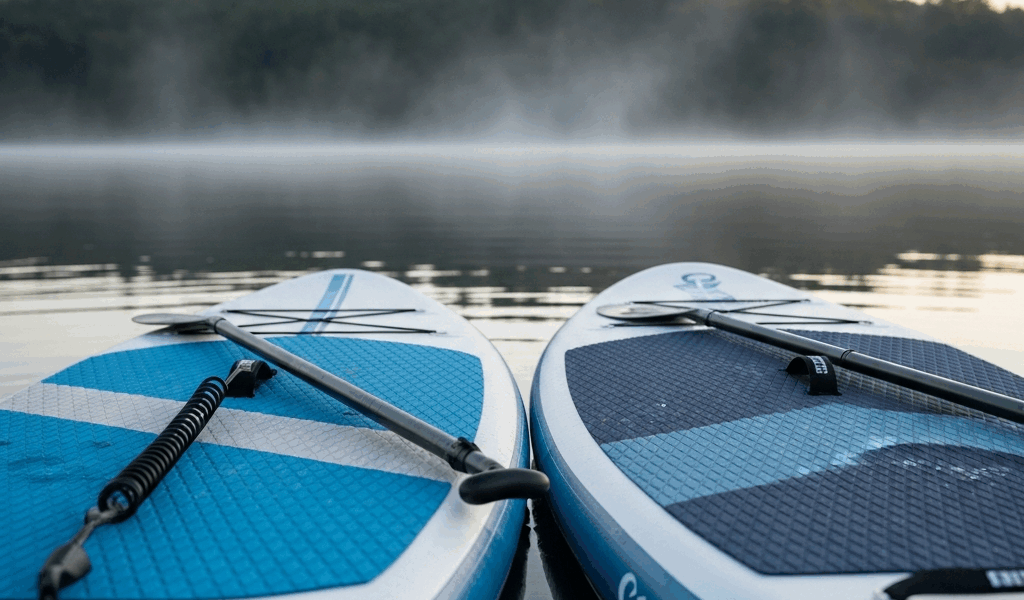
The inflatable vs hard paddleboard debate has gotten complicated with all the brand noise flying around — mostly because the loudest voices usually only sell one type. As someone who owns both and has paddled everything from glassy mountain lakes to choppy coastal bays, I learned everything there is to know about this particular argument the hard way. My quiver right now: a 10’6″ Red Paddle Co Ride inflatable I’ve beaten up for four years, and a 9’0″ Starboard Wedge hard epoxy board I grabbed secondhand specifically for surf. Here’s where I landed: roughly 80% of recreational paddlers should just buy the inflatable and stop second-guessing themselves.
This article includes affiliate links. We may earn a commission at no extra cost to you.
Storage is the first reason — and it’s not close. Most people don’t live on the water. They live in apartments, third-floor walkups, shared garages with one parking spot and someone else’s bikes already hanging from the ceiling. A deflated inflatable rolls down to roughly the size of a large duffel bag. The Red Paddle Co Ride packs into a backpack that fits in a car trunk alongside actual groceries. A hard board is 9 to 12 feet long and won’t slide inside most vehicles without a roof rack bolted on. That’s a logistical wall — and it quietly kills how often people actually paddle.
Portability is the second reason. I used to live on the third floor of a walkup in the city — no elevator, narrow stairwell, neighbors who would absolutely not help me wrestle a fiberglass board up two flights at 7am on a Saturday. The inflatable went over one shoulder, pump in the other hand, door-to-door in a single trip. That convenience translated directly into paddling more often. Don’t make my mistake of underestimating how much friction in your routine shapes your actual behavior. The best board is the one you use.
Modern inflatables have also crossed a performance threshold that makes the old arguments against them feel embarrassingly dated. We’re not talking about the $200 big-box-store boards anymore. A quality inflatable at 15 PSI is genuinely rigid — I put my Red Paddle Co on sawhorses and stood dead-center, and the flex was barely perceptible. The construction has improved that much over the past decade.
- Storage — rolls into a backpack, fits in any closet or car trunk
- Transport — no roof rack required, flies as checked luggage
- Durability for beginners — bounces off rocks without damage
- Price-to-performance ratio — better at the $600–$1,000 entry range
- Safety — softer impact if it hits you or someone else in the water
Probably should have opened with this section, honestly. The storage and transport advantages are so decisive for most people’s actual lives that performance nuances barely register until you’re an intermediate or advanced paddler chasing something specific.
Where Hard Boards Still Win
That said — hard boards are genuinely better in specific situations, and I’d be doing you a disservice to pretend otherwise.
SUP Surfing
The difference on a wave is not subtle. Hard boards respond immediately — rail-to-rail, no delay. When I’m on my Starboard Wedge and dig a back rail into a wave’s shoulder, the board snaps. An inflatable has a measurable lag — a slight mushiness that, on flatwater, is completely imperceptible, but on a wave costs you critical timing. That’s what makes a hard surf shape endearing to us wave-chasers. If surfing is your primary use case, buy a hard board. Full stop.
Racing and Long-Distance Touring
Glide efficiency matters enormously when you’re covering distance. Hard boards have sharper hull profiles and denser construction — more glide per stroke. I timed myself on identical flat-water courses with both boards: 1 nautical mile, calm conditions, same paddle, same paddler. The Starboard covered it noticeably faster at the same effort level. For casual paddling, you probably won’t notice. For a 10-mile coastal tour or any racing format, you will.
Competitive SUP racing at any serious level is almost exclusively hard boards. The 14′ race-specific shapes from Naish, Starboard, and SIC Maui are purpose-built in carbon fiber or fiberglass layups — weight and hydrodynamic efficiency that an inflatable simply cannot replicate.
High-Performance Downwind Paddling
Downwind paddling — catching runners in open ocean swells — requires a board that reacts instantly to small energy transfers from moving water. Hard boards catch bumps that inflatables miss entirely. This is a niche use case, honestly. But if you live somewhere like the Columbia River Gorge or paddle the channel between Molokai and Oahu, it matters more than anything else on this list.
Durability Myth-Busting
But what is the real durability story here? In essence, it’s the opposite of what most people assume. But it’s much more than that — it’s situational in ways that actually determine which board survives your specific paddling life.
Hard boards are fiberglass or epoxy over an EPS foam core. They look bulletproof. They are not. A single encounter with a submerged rock, a concrete boat ramp, or even a careless moment dropping the board on pavement can crack the fiberglass skin. That crack lets water into the foam core — delamination — and if you don’t repair it fast, the core absorbs water and the board becomes heavy, waterlogged, and eventually garbage. I’ve seen beautiful $1,400 boards destroyed after one bad shore landing.
Frustrated by a parking lot curb on my second week with the Starboard, I ended up doing a fiberglass repair using a Solarez UV resin kit — a small orange bottle, some sanding paper, and about two hours in my driveway. The board still has a slightly cloudy patch where it happened. Probably always will.
Military-grade PVC — the construction used in quality inflatables like Red Paddle Co, iRocker, and Thurso Surf — is tough in a fundamentally different way. It doesn’t crack on impact. It absorbs collisions with rocks, pilings, and boat hulls without leaving a mark. The real vulnerability is puncture — a fishhook, a barnacled rock edge — but this is far less common than the blunt impact damage that quietly destroys hard boards on regular rocky launches.
The honest durability verdict is situational. Rock gardens, technical rivers, rocky shorelines — inflatable wins, clearly. Long-term storage in hot conditions — an unventilated garage in Georgia or Arizona — can weaken PVC over time, while hard boards handle heat storage better. Neither type is invincible. Both require care. Don’t let anyone tell you otherwise.
Performance on the Water — Side by Side
Tracking
Tracking — how well a board holds a straight line — gets cited constantly as an inflatable weakness. This is true at the budget end. A $299 generic-brand inflatable will wander. A $900+ inflatable with a proper displacement hull shape and a quality fin setup tracks cleanly. My Red Paddle Co at 10’6″ tracks as well as most recreational hard boards I’ve paddled at the same length. The fin matters enormously — a US fin box with a 9″ center fin solves most tracking issues on any board, inflatable or hard.
Stability
Volume and width determine stability far more than material. A 32″-wide inflatable will be more stable than a 29″-wide hard board, full stop, regardless of what it’s made from. Beginners consistently overestimate how much material affects stability and underestimate how much board dimensions matter. A 10’6″ x 32″ inflatable at 250 liters of volume is a stable platform. That’s just geometry.
Budget vs Budget
This is where the comparison gets genuinely useful for most buyers. At the $400–$600 price point, a mid-range inflatable — the iRocker Cruiser 10’6″ retails around $599 — will outperform a hard board at the same price. Hard board construction costs are simply higher. A $500 hard board is often a low-quality foam and fiberglass layup that performs mediocrely and dings at the first opportunity. That same $500 in an inflatable buys dual-layer PVC construction and a usable fin setup. At $400–$600, buy the inflatable — apparently this is still a controversial opinion in some corners of the SUP community, but it really shouldn’t be.
Spend $1,200 or more and the calculus shifts. High-end hard boards — hand-shaped epoxy, carbon fiber reinforcement, refined hull geometry — start showing their performance advantages clearly. The Red Paddle Co Ride and the Starboard Wedge I own are both in the $1,000–$1,500 range, and at that price, the hard board’s performance edges become real and noticeable on the water.
The Right Board for Your Situation
Answer these questions honestly and the decision almost makes itself.
Where Do You Live
Apartment, condo, or anywhere without dedicated board storage — inflatable, no debate. A deflated 10’6″ inflatable stores in a closet. A hard board does not. If you have to leave a hard board outside or pay for storage space separately, that friction will quietly erode how often you actually paddle. Paddling less often defeats the entire purpose.
Waterfront home, beach house, or a garage with clear wall space — either type works. Wall racks for hard boards cost $30–$60 and mount in about an hour on a Sunday morning. If storage isn’t your constraint, move to the next question.
What Do You Want to Do on the Water
Casual flatwater paddling, yoga sessions, recreational lake mornings, paddling with kids or friends — inflatable. Every time. The performance difference is invisible at this use level, and the practical advantages of an inflatable dominate completely.
SUP surfing, even occasionally — hard board. This is the clearest performance case. The handling difference is noticeable on your first real wave, not your tenth. A 9’0″ hard board shape will make surfing genuinely more rewarding — faster to respond, more satisfying underfoot.
Touring more than 5 miles regularly — hard board, or a premium inflatable like the Red Paddle Co Sport or iRocker All-Around Ultra might be the best option, as serious distance touring requires genuine glide efficiency. That is because accumulated inefficiency per stroke compounds significantly over 8 to 10 miles of open water.
Do You Travel With Your Board
Travel — inflatable, definitively. Airlines charge oversized fees for hard board bags and the damage risk during baggage handling is genuinely real. An inflatable in a rolling travel bag checks like standard luggage on most carriers. I’ve flown with my Red Paddle Co to three different countries — packed it into a rolling duffel bag, checked it at the counter like a normal piece of luggage, and it arrived undamaged every time. That’s not a gamble I’d take with a fiberglass board in an airline cargo hold.
Are You a Beginner
Yes — inflatable, without hesitation. The forgiveness on rocky launches, the softer impact if the board hits you mid-fall, and the storage practicality all point the same direction. Learn on an inflatable, then decide if specific performance goals push you toward a hard board once you know what kind of paddling you actually love most. While you won’t need to demo fifteen different boards, you will need a handful of real sessions before you know whether surfing, racing, or flatwater touring is your thing.
First, you should figure out where you’ll store a board — at least if you don’t have a garage or a ground-floor space. The bottom line after four years of owning both: inflatables have earned their dominance in the recreational market. They are not a compromise for people who can’t afford a real board. They are the right tool for the way most people actually paddle. Buy the hard board when you know exactly why you need it — surfing, racing, performance touring — and that specificity will make the investment worthwhile. Buy the inflatable for everything else, and don’t let anyone tell you you’ve settled.


Stay in the loop
Get the latest seattle paddleboard updates delivered to your inbox.